

Bathroom sink faucets are not all classified in the same way. Centerset, widespread, and single-hole describe the faucet’s mounting configuration and the number or spacing of sink holes. Vessel faucet describes a taller faucet designed to work with a vessel sink. Wall-mount describes where the faucet is installed.
The first compatibility check is always the sink or countertop. Measure the number of holes and the center-to-center distance between the outer holes. Then match the faucet type to the sink, available space, and installation method.
The Two Main Ways Faucets Are Classified
Mounting configuration
This describes how the faucet is installed on the sink or countertop:
- Single-hole
- Centerset
- Widespread
- Wall-mount
Sink or use case
This describes the type of sink or application the faucet is designed for:
- Vessel faucet
- Standard bathroom sink faucet
Vessel faucet is therefore not a separate mounting standard. A vessel faucet may use a single-hole or widespread deck layout, or it may be wall-mounted.
How to Measure Your Sink Before Choosing a Faucet
- Count the predrilled holes in the sink or countertop.
- Measure from the center of the far-left hole to the center of the far-right hole.
- Record the hole diameter and available space below the sink.
- Check whether the sink deck has enough room for the faucet base or separate handles.
- Confirm the faucet’s minimum and maximum spread when applicable.
Do not rely on the sink’s exterior width. The hole layout and faucet footprint determine compatibility.
Single-Hole Faucets
A single-hole faucet combines the spout and control into one body that passes through one mounting hole. It is often chosen for compact vanities and modern designs because the deck remains visually clean.
Key characteristics
- Uses one mounting hole.
- Integrates the spout and handle or handles into one body.
- Can fit a three-hole sink only when the manufacturer supplies a compatible deck plate.
- May include a single lever, dual controls, or a pull-down sprayer depending on the model.
Best suited to
- Small bathrooms and powder rooms.
- Modern or minimalist vanities.
- Sinks where maximum countertop space is useful.
Compatibility note
A three-hole sink does not automatically accept every single-hole faucet. The deck plate must cover the unused holes and be approved for that faucet model.
Centerset Faucets
A centerset faucet is a compact, integrated fixture designed for a three-hole sink with 4-inch center-to-center spacing. The spout and handles sit on one base plate.
Key characteristics
- Requires three holes.
- Uses the standard 4-inch center-to-center layout.
- Combines the spout and handles on one deck plate.
- Has a compact footprint and generally simpler installation than a widespread faucet.
Best suited to
- Standard bathroom vanities.
- Small powder rooms and guest bathrooms.
- Pedestal sinks with a standard 4-inch hole spread.
Compatibility note
A centerset faucet cannot normally replace a widespread faucet. The 4-inch base will not cover the wider holes of an 8-inch or larger spread.
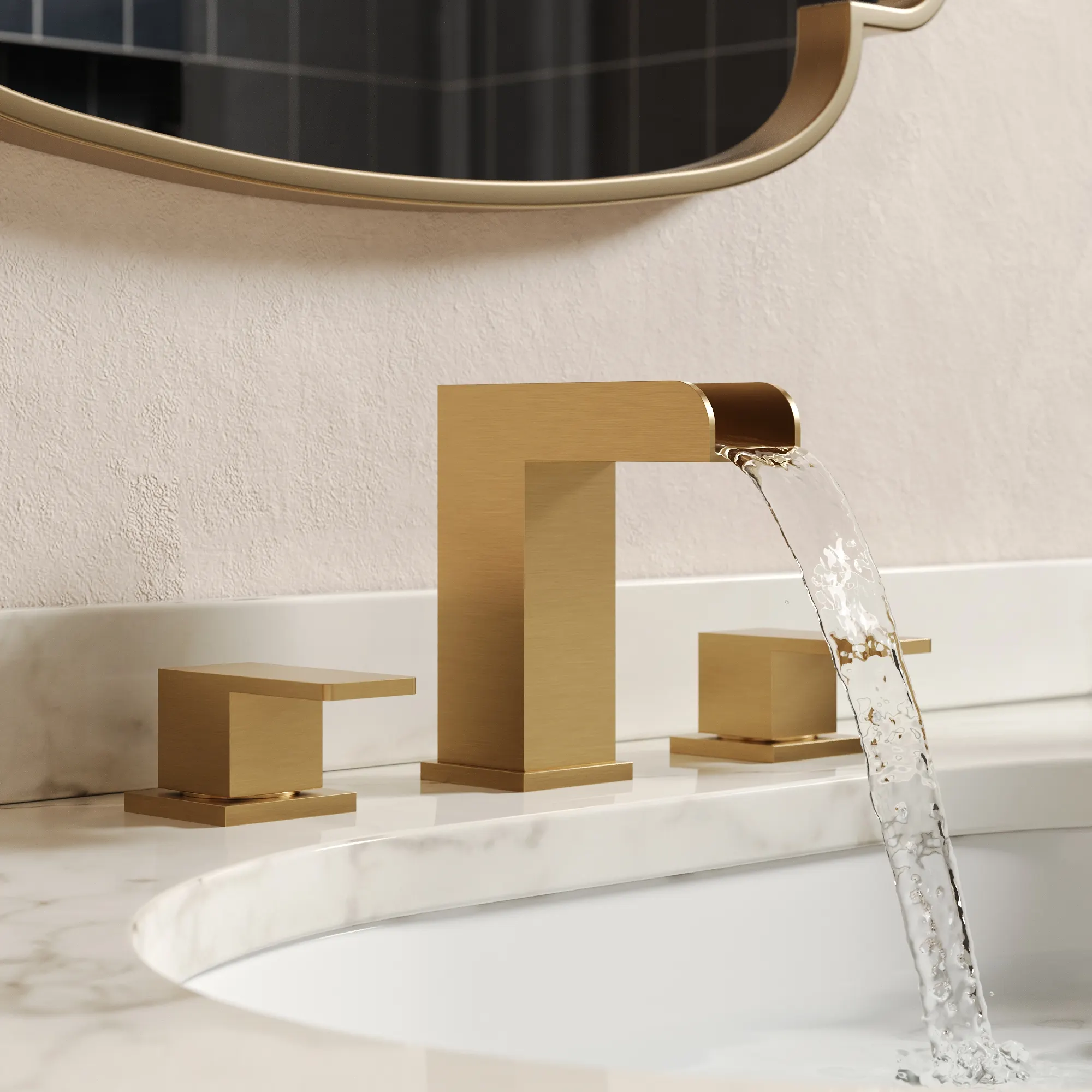
Widespread Faucets
A widespread faucet has three separate components: a central spout and independent hot and cold handles. Each component uses its own hole, and the handle spacing is often adjustable.
Key characteristics
- Requires three holes.
- Uses a wider layout, commonly starting around 8 inches between handle centers.
- Allows the handles to be positioned for a balanced custom look.
- Provides more open space around the spout and handles for cleaning.
Best suited to
- Larger vanities and primary bathrooms.
- Traditional, transitional, or high-end designs.
- Sinks where a more spacious and architectural look is desired.
Compatibility note
Handle spacing must be confirmed against the sink’s predrilled holes and the faucet’s allowed range. A widespread faucet normally cannot replace a centerset model unless the sink or countertop is replaced.
[Insert the main image from “What Is a Widespread Faucet?” here. Suggested ALT: Widespread bathroom faucet with separate spout and handles on a vanity.]
Vessel Faucets
A vessel sink sits above the countertop, so it needs a faucet with enough spout height and reach to deliver water into the bowl without excessive splashing.
Key characteristics
- Taller spout than a standard bathroom faucet.
- Longer reach to clear the vessel rim.
- Can be deck-mounted or wall-mounted.
- May use a single-hole, widespread, or other compatible mounting configuration.
Best suited to
- Vessel sinks.
- Statement vanities where the sink is a visual focal point.
- Bathrooms with enough counter depth for the sink and faucet.
Compatibility note
Vessel faucet is a use-case description, not a hole configuration. Measure the sink height, bowl diameter, faucet reach, splash distance, and counter depth together.
Wall-Mount Faucets
A wall-mount faucet is installed through the wall behind the sink rather than on the sink deck. The rough-in valve and supply connections sit inside the wall.
Key characteristics
- No faucet holes are required in the sink or countertop.
- Leaves the countertop clear.
- Requires precise rough-in height, depth, and spout reach.
- Is easiest to plan during a remodel before the wall is closed and tiled.
Best suited to
- Vessel sinks and undermount sinks.
- Clean, minimalist, or custom bathroom designs.
- Projects where the wall is already open for plumbing work.
Compatibility note
Once the wall is closed, corrections are expensive. Confirm the faucet model, rough-in valve, wall thickness, sink position, and service access before installation.
Faucet Type Comparison
| Faucet type | Holes required | Standard spacing | Classification | Best use |
|---|---|---|---|---|
| Single-hole | 1 | Not applicable | Mounting configuration | Small or modern vanities |
| Centerset | 3 | 4 inches | Mounting configuration | Compact standard bathrooms |
| Widespread | 3 | Often 8 inches or more, adjustable by model | Mounting configuration | Larger vanities and custom designs |
| Vessel | Depends on model | Depends on mounting style | Sink/use case | Vessel sinks |
| Wall-mount | None in the sink deck | Wall rough-in spacing | Installation method | Vessel, undermount, and custom layouts |
Can You Replace One Faucet Type With Another?
Centerset to widespread
Usually not. The wider holes are outside the centerset base, and the spacing generally does not match.
Widespread to centerset
Usually not. A centerset base is unlikely to cover the wider holes and may leave an exposed opening.
Three-hole to single-hole
Often possible when the faucet manufacturer provides a compatible deck plate that covers the unused holes.
Deck-mount to wall-mount
This is a plumbing and wall-construction change, not a simple faucet replacement. The rough-in valve must be installed at the correct height and depth before the wall is finished.
Frequently Asked Questions
How do I know which faucet type will fit my sink?
Count the holes and measure the center-to-center distance between the outer holes. A 4-inch three-hole layout indicates a centerset faucet. A wider layout generally indicates a widespread faucet. A single hole supports a single-hole faucet or a compatible deck-mounted option.
Can I replace a centerset faucet with a widespread faucet?
Usually no, unless the sink or countertop is replaced. The existing 4-inch holes will not align with the wider widespread layout.
Is a vessel faucet a mounting type?
No. Vessel describes the sink and the taller faucet geometry needed to reach over it. The faucet can still be single-hole, widespread, or wall-mounted.
What is the standard spacing for a widespread faucet?
Many widespread faucets begin around 8 inches between handle centers, but the allowed range varies by model. Check the product specifications rather than assuming a fixed spread.
Do wall-mount faucets need sink holes?
No. The faucet connects to plumbing inside the wall, so the sink deck can remain unperforated.
Final Takeaway
Start with the sink’s hole layout. Count the holes and measure the outer centers before choosing a faucet. Then use the type descriptions above to understand whether the design is defined by its mounting method, its sink application, or a combination of both.
For a reliable fit, confirm the faucet type, spread range, sink clearance, deck-plate requirements, and rough-in dimensions before ordering. Explore GRANDJOY bathroom faucets for coordinated options.


Leave a comment
This site is protected by hCaptcha and the hCaptcha Privacy Policy and Terms of Service apply.