

When you're dealing with hard water, the best defense is a great offense. The best bathroom faucets for this challenge are typically built with a solid brass or stainless steel body, finished in a spot‑resistant coating such as brushed nickel or matte black, and engineered with ceramic disc valves inside. This combination helps reduce the impact of mineral buildup, improves corrosion resistance, and makes water spots less noticeable in everyday use.
The Hidden Damage of Hard Water in Your Bathroom
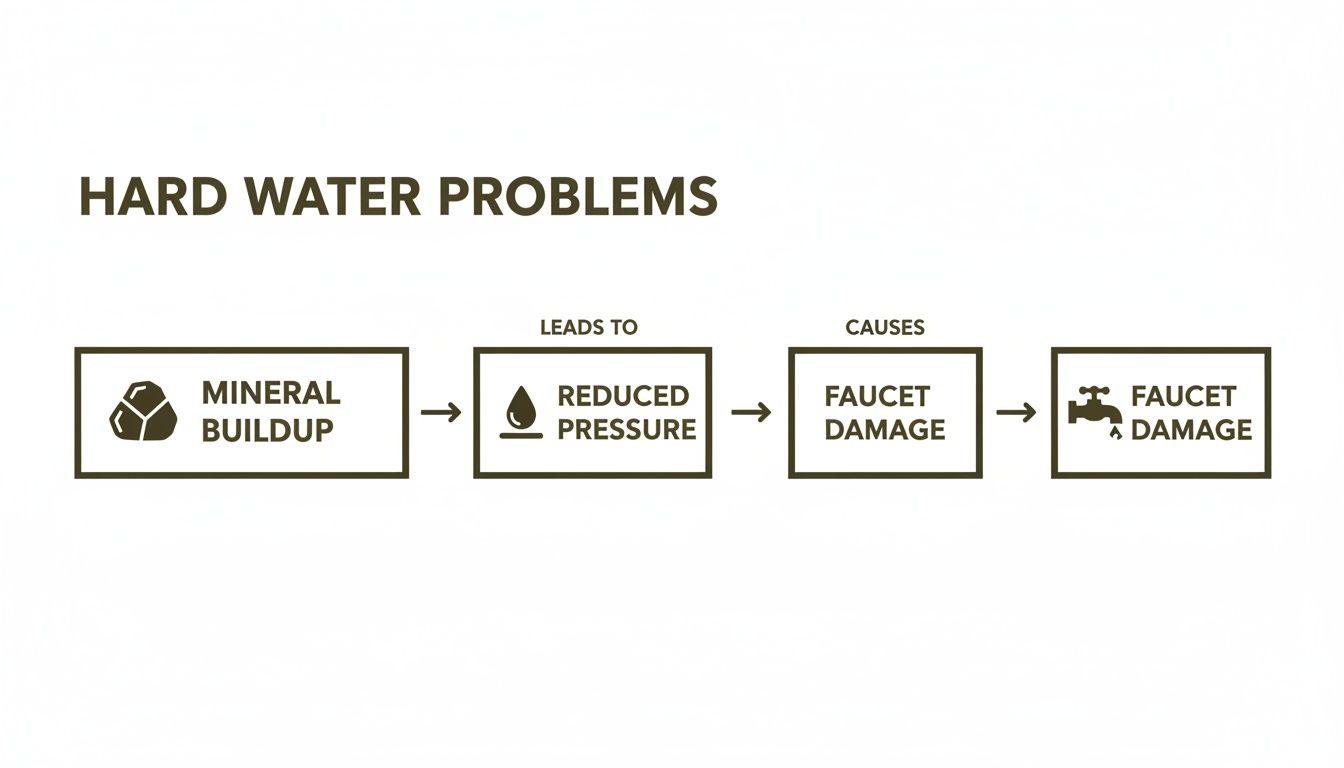
That chalky white film clinging to your faucet isn't just an ugly stain; it's the tip of the iceberg. Hard water—water with higher levels of dissolved minerals like calcium and magnesium—gradually deposits scale on and inside your fixtures. Over time, this buildup can affect both appearance and performance.
You might first notice stubborn water spots that keep returning after cleaning, or a stream that feels weaker than it used to. These are visible signs of what hard water is doing inside the faucet and plumbing.
More Than Just a Cleaning Nuisance
At first, hard water seems like a simple cleaning issue: you wipe away white residue, only for it to return. The more serious problems often develop out of sight, inside the faucet’s small passages and moving parts.
Common hard‑water‑related issues include:
-
Reduced water flow – Mineral deposits (scale) can clog the aerator screen and narrow internal channels, restricting water flow and weakening the stream.
-
Stiff handles and drips – Scale can interfere with seals and moving parts, making handles harder to turn and increasing the likelihood of drips.
-
Internal corrosion – Certain lower‑grade metals are more vulnerable to corrosion in mineral‑rich water, which can shorten the functional life of the faucet.
Many regions, particularly in North America and Europe, report that a large portion of households are supplied with hard or very hard water, which makes choosing suitable materials and finishes for fixtures especially important.
The Financial Impact of Mineral Buildup
Hard water can also affect your wallet. When water hardness exceeds about 7 grains per gallon (gpg)—commonly defined as “hard” water—scale formation on fixtures, aerators, and appliances becomes increasingly likely over time. If left unmanaged, this buildup can:
-
Clog faucet aerators and showerheads
-
Reduce water pressure at fixtures
-
Contribute to more frequent cleaning and maintenance
-
Accelerate wear on some plumbing components and water‑using appliances
Water‑treatment and plumbing professionals frequently note that addressing hard water at the fixture level (with better materials and finishes) and, where practical, at the system level (with softening or filtration) can help reduce long‑term maintenance costs.
Choosing one of the best bathroom faucets for hard water is therefore not just about looks—it’s also a practical investment in your home’s long‑term performance.
Choosing Faucet Materials That Stand Up to Mineral Buildup
The core material of your faucet is its first line of defense against hard water. While the finish is what you see, the metal underneath largely determines how well the faucet will handle years of exposure to mineral‑rich water.
Lower‑grade metals and thin alloys can be more prone to internal corrosion and damage from scale, while higher‑quality alloys are designed to resist these effects.
Why Solid Brass Is a Proven Standard
For bathroom faucets in hard‑water areas, solid brass is widely regarded as one of the most reliable choices. Brass—an alloy primarily of copper and zinc—has long been used in plumbing because of its strength and good corrosion resistance in potable‑water systems.
Key advantages of solid brass in hard‑water conditions:
-
Corrosion resistance – Brass resists many forms of corrosion better than common zinc‑based alloys, especially when used with appropriate finishes and under normal household conditions.
-
Stable internal surfaces – A properly manufactured brass body provides smooth internal passages that are comparatively less prone to pitting than some lower‑cost metals, which supports more consistent flow over time.
-
Proven track record – Brass has been used in faucets and valves for decades, and is still described by many industry guides as the “gold standard” for long‑term durability, including in hard‑water regions.
Industry resources and faucet manufacturers regularly highlight solid brass bodies as a top choice for fixtures expected to endure harsher water conditions.
Evaluating Other Faucet Materials
While solid brass is a leading option, other materials also play important roles in bathroom faucets for hard water.
304 Stainless Steel
304 stainless steel is another high‑quality material commonly recommended for fixtures in challenging environments. It offers:
-
Very good resistance to rust, corrosion, and staining due to its chromium‑rich composition, which forms a protective oxide layer on the surface.
-
A modern, sleek appearance that pairs well with contemporary bathroom designs.
Many guides on hard‑water faucets list brass and stainless steel as the preferred base materials because they provide strong resistance to corrosion and mineral‑related damage when properly manufactured and finished.
Zinc Alloys
Zinc and zinc‑based alloys are often used in budget‑oriented faucets. While they can be adequate in some soft‑water applications, they are generally considered less suitable for long‑term use in hard‑water environments, because they tend to be more vulnerable to corrosion over time once the protective finish is compromised.
Plastics and Polymer Components
Certain plastic components are sometimes used in faucet internals or decorative parts. Plastics do not rust, but they typically offer lower mechanical strength and heat resistance than brass or stainless steel. They can be acceptable for low‑stress parts or temporary installations, but they are not usually recommended as the primary structural material for a hard‑water bathroom faucet.
Making a Smart Material Choice
In short, if you live with hard water, choosing a faucet with a solid brass or high‑grade stainless steel body is a smart way to build in durability from the start. While lower‑cost alloys may reduce the initial price, they often require closer monitoring and may not provide the same long‑term resilience in mineral‑rich water.
Selecting Finishes That Help Conceal Water Spots
While the internal material protects against structural damage, the exterior finish is what you interact with daily. In hard‑water homes, the wrong finish can quickly show water spots and mineral deposits, making the faucet look dirty even when it’s perfectly clean.
Highly polished, mirror‑like surfaces act like a spotlight for every drop that dries on them. By contrast, softer, brushed, or matte finishes are much better at disguising minor mineral residue until your next regular cleaning.
Why Polished Finishes Highlight Water Spots
Finishes such as polished chrome and polished nickel have a bright, reflective sheen. In hard‑water environments:
-
Mineral residues left behind after droplets evaporate appear as light‑colored rings or spots.
-
These marks contrast strongly with the reflective surface, making them more noticeable.
Many homeowners find that keeping polished finishes spotless in hard‑water conditions requires frequent wiping or polishing.
Finishes That Work With Hard Water Instead of Against It
If you prefer a faucet that looks cleaner with less effort, consider finishes designed to make spots less visible. Many manufacturers and design resources recommend the following in hard‑water areas:
-
Brushed nickel – A soft, brushed texture diffuses light and makes mineral spots blend into the surface, helping them stand out less.
-
Satin brass – Offers a warm, low‑sheen look; the muted glow helps camouflage light residue better than high‑polish brass.
-
Matte black – A non‑reflective surface that generally hides water spots and fingerprints well, especially when combined with a durable coating.
-
Oil‑rubbed bronze – Dark, variegated tones naturally disguise small spots and marks.
Independent articles on faucet finishes for hard water frequently list brushed or satin finishes—especially brushed nickel—as top choices because they reduce the visible contrast of typical grayish‑white mineral deposits.
Making the Right Visual Choice
Your ideal finish is the one that balances your aesthetic preferences with the reality of your water quality. If you love the look of a high‑gloss chrome faucet and don’t mind frequent cleaning, it can still be a beautiful choice. But if you want a finish that stays “forgiving” between cleanings in a hard‑water home, brushed, satin, or matte finishes are often more practical.
Inside a Hard‑Water‑Resistant Faucet
Beyond materials and finishes, a faucet’s internal engineering plays a crucial role in how well it withstands hard water. Two key technologies to look for are ceramic disc valves and advanced finishing processes such as Physical Vapor Deposition (PVD).
The Unseen Hero: Ceramic Disc Valves
The valve mechanism is the heart of the faucet. In older compression‑style faucets, rubber washers and soft seals were more vulnerable to wear and mineral buildup. In contrast, modern ceramic disc valves use two precisely machined ceramic discs that slide against each other to open and close the water passage.
Advantages of ceramic disc valves in hard‑water areas:
-
Improved wear resistance – Ceramic materials are extremely hard and resistant to abrasion from small mineral particles.
-
Better sealing – The smooth, flat surfaces can maintain a tight seal with minimal friction.
-
Reduced sensitivity to scale – While no valve is completely immune to deposits, ceramic discs are generally less affected by mineral buildup than traditional rubber‑washer designs.
Because of these benefits, many reputable faucet manufacturers recommend ceramic disc cartridges for long‑term reliability in regions with hard water.
The Role of PVD Finishes
Just as the valve needs protection on the inside, the finish needs protection on the outside. Physical Vapor Deposition (PVD) is an advanced finishing process that creates a very hard, tightly bonded surface layer on metal components.
Key benefits of PVD in hard‑water environments:
-
Enhanced scratch resistance – The hard surface resists many small scratches that could otherwise dull the finish.
-
Improved corrosion resistance – A well‑applied PVD layer forms a protective barrier that helps shield the underlying metal from corrosive elements in the environment.
-
Better color stability – PVD finishes are designed to retain their appearance over time, often better than many traditional electroplated finishes when properly cared for.
Because of these properties, PVD is increasingly used on brushed nickel, matte black, and other premium finishes intended for use in bathrooms and kitchens where water exposure is constant.
When you choose a faucet that combines a solid brass or stainless steel body, a ceramic disc valve, and a PVD‑type finish, you’re selecting a fixture that has been engineered from the inside out to handle the stresses of hard water more effectively.
Smart Maintenance for Hard Water Faucets
Even the best faucet benefits from good care habits, especially in hard‑water homes.
How Can I Safely Clean Limescale Off My Faucet Finish?
For removing minor mineral buildup from bathroom faucets:
-
Start with a soft microfiber cloth and warm water to loosen deposits.
-
Use a small amount of mild, pH‑neutral dish soap mixed with water to gently wipe affected areas.
-
Rinse thoroughly with clean water and dry the faucet with a separate cloth to reduce new spotting.
Always follow the care instructions recommended by the faucet manufacturer for your specific finish. Many brands advise avoiding strong, acid‑based descalers, abrasive pads, and harsh chemicals on PVD or lacquered finishes, as they can damage protective coatings over time.
Is a Water Softener Still Useful If I Choose a Hard‑Water‑Optimized Faucet?
Yes. A faucet built for hard water is designed to withstand mineral exposure better, but it doesn’t remove those minerals from the water itself. A water softener or other treatment system:
-
Protects pipes, appliances, and all fixtures in the home
-
Reduces the rate of scale buildup inside plumbing
-
Makes cleaning sinks, tubs, and glass surfaces easier
Using both a well‑designed faucet and, where practical, water treatment gives you the most comprehensive protection.
How Can I Tell If a Faucet Uses High‑Quality Materials?
To assess whether a faucet is built with materials suitable for hard water, consider:
-
Product specifications – Check if the faucet body or key components are described as solid brass or 304 stainless steel.
-
Weight and feel – Quality metal faucets generally feel more substantial than those made primarily from thin alloys or plastics.
-
Certifications and warranty – Reputable manufacturers highlight third‑party certifications (such as cUPC and lead‑content standards) and often back their faucets with strong warranties, which is a good indicator of confidence in materials and construction.
Where GRANDJOY Shines in Hard Water Environments
GRANDJOY faucets are designed with hard‑water performance in mind, combining materials, finishes, and internal components that address the most common challenges of mineral‑rich water.
Key design priorities include:
-
Solid metal construction – Using premium metals such as solid brass for the faucet body to enhance corrosion resistance and long‑term durability.
-
Ceramic disc cartridges – Providing smooth handle operation and robust sealing performance that better resists wear and mineral‑related issues than traditional washer‑based systems.
-
Advanced finishes – Applying durable, spot‑resistant finishes (including PVD‑type technologies on selected models) in popular options such as brushed nickel, satin brass, and matte black, chosen specifically to perform well in bathrooms exposed to hard water.
Our faucets are engineered to meet widely recognized plumbing and material standards, so professionals and homeowners alike can choose them with confidence for use in hard‑water regions.
Ready to Upgrade for Hard Water?
If you’re ready to upgrade to a bathroom faucet that’s built to handle hard water, look for three essential elements:
-
A solid brass or stainless steel body
-
A ceramic disc valve cartridge
-
A durable, spot‑resistant finish such as brushed nickel, satin brass, or matte black
The GRANDJOY collection brings these elements together to deliver fixtures that are not only stylish, but also thoughtfully designed for long‑term performance in real‑world water conditions. Explore our bathroom faucet collections and find the right solution for your home.


Leave a comment
This site is protected by hCaptcha and the hCaptcha Privacy Policy and Terms of Service apply.