
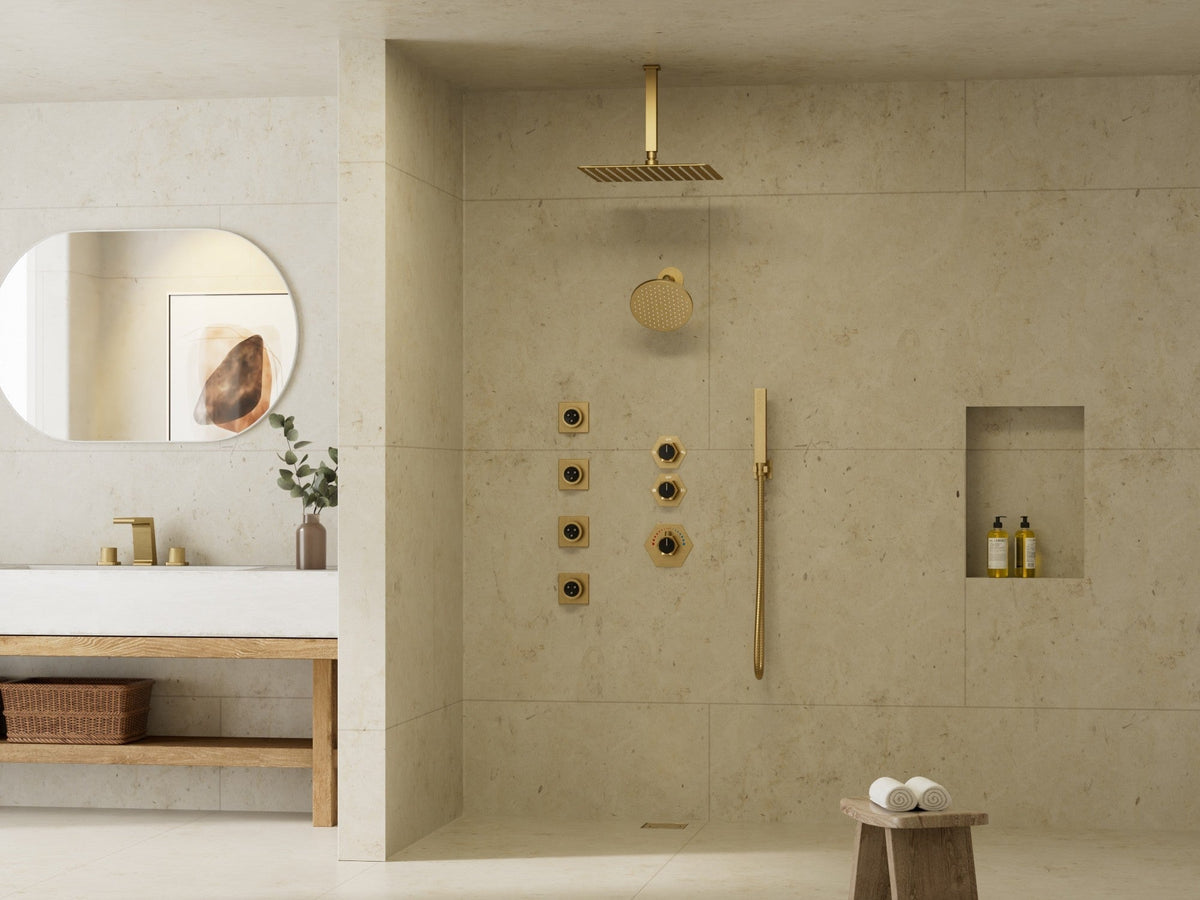
Thermostatic mixing valve, thermostatic shower valve, and anti-scald valve are related terms, but they do not always mean the same thing. A thermostatic mixing valve controls temperature by mixing hot and cold water. A thermostatic shower valve is a thermostatic valve designed for a shower. An anti-scald valve is a broader category that includes both thermostatic and pressure-balancing designs.
The most important distinction is the job each term describes. Thermostatic control is a method; anti-scald protection is a safety outcome; and a shower valve is the installed product that performs the function in a shower system.
Quick Definitions
| Term | What it means | Main purpose |
|---|---|---|
| Thermostatic mixing valve | A valve that senses mixed-water temperature and adjusts the hot and cold flow to maintain a set outlet temperature. | Precise temperature control and protection against temperature changes. |
| Thermostatic shower valve | A thermostatic valve configured for a shower, usually installed behind the wall and paired with compatible trim. | Stable shower temperature with an adjustable maximum-temperature limit. |
| Anti-scald valve | A general term for a valve designed to reduce sudden temperature changes and lower scald risk. It may be pressure-balancing or thermostatic. | Thermal-shock and scald protection. |
| Pressure-balancing valve | A valve that responds mainly to changes in hot and cold water pressure. | Prevent sudden temperature swings when another fixture uses water. |
The terms overlap because many thermostatic shower valves also provide anti-scald protection. However, “anti-scald” does not automatically mean “thermostatic,” and not every temperature-control valve is a complete shower system.
[Insert optional image here: use the main image from “What Is a Thermostatic Shower Valve? | Quick Safety Guide.” Suggested ALT: Modern thermostatic shower with wall-mounted temperature controls.]
What Is a Thermostatic Mixing Valve?
A thermostatic mixing valve, often shortened to TMV, blends hot and cold water to produce a controlled outlet temperature. It is sometimes compared to a thermostat for water because it continuously responds to temperature changes.
Instead of relying only on handle position, the valve senses the temperature of the mixed water. When the outlet becomes too hot, it reduces hot-water flow and allows more cold water into the mix. When the water becomes too cool, it does the opposite.
This makes a thermostatic mixing valve useful when:
-
Supply temperatures change during use.
-
Another fixture causes a drop in cold-water pressure.
-
A shower needs a stable set temperature.
-
A maximum outlet temperature must be limited for safety.
Thermostatic mixing valves may be used in showers, tub-and-shower systems, and some commercial or multi-outlet applications. The exact configuration depends on the system design, local requirements, and the manufacturer’s instructions.
What Is a Thermostatic Shower Valve?
A thermostatic shower valve performs thermostatic mixing for a shower. It is usually part of a concealed shower system and includes:
-
A rough-in valve body installed behind the wall.
-
A thermostatic cartridge or element.
-
Hot and cold inlets.
-
One or more mixed-water outlets.
-
A compatible trim, handle, and faceplate.
Some thermostatic shower valves control temperature only. Others combine temperature control with a separate volume or diverter control. The shower may feed a fixed showerhead, hand shower, body sprays, or several outlets.
A critical feature is the adjustable maximum-temperature limit stop. During commissioning, the installer adjusts the valve while measuring the outlet temperature. Once set, the handle cannot normally be turned beyond the selected high-temperature limit.
The rough-in valve and trim should normally be selected as one compatible system. Parts from different brands may look compatible but differ in cartridge geometry, mounting depth, outlet position, or flow design.
What Is an Anti-Scald Valve?
An anti-scald valve is designed to reduce the risk of sudden hot-water exposure and thermal shock. It is a category of protection rather than one specific internal design.
The two common approaches are:
Pressure-balancing anti-scald valve
This type responds mainly to changes in hot and cold water pressure. If cold-water pressure drops because a toilet or appliance is using water, the valve limits hot-water flow to avoid a sudden temperature spike.
Thermostatic anti-scald valve
This type senses the mixed-water temperature directly and adjusts the hot and cold proportions to maintain the setpoint. It generally provides more precise temperature control than a basic pressure-balancing valve.
Some thermostatic designs also reduce or stop flow when the cold-water supply fails. The exact behavior depends on the model and certification.
Pressure-Balancing vs Thermostatic Control
| Question | Pressure-balancing valve | Thermostatic valve |
|---|---|---|
| What does it sense? | Changes in hot and cold pressure | Mixed-water temperature |
| What is it best at? | Preventing sudden temperature swings | Maintaining a stable set temperature |
| Does it provide a temperature limit stop? | Usually provides thermal-shock protection, but design varies | Commonly includes an adjustable maximum-temperature limit |
| How precise is temperature control? | Basic | Generally more precise |
| Can it react to changing supply temperature? | Indirectly through pressure changes | Directly through temperature sensing |
If the main concern is protection from a pressure drop elsewhere in the home, a pressure-balancing valve may be sufficient. If the goal is stable temperature and a precise maximum limit, a thermostatic valve is usually the stronger choice.
How a Thermostatic Valve Works
Most thermostatic valves use a temperature-sensitive element such as a wax capsule or a similar mechanism.
-
Hot and cold water enter the valve.
-
The element senses the temperature of the mixed water.
-
If the water becomes hotter than the setpoint, the element expands and reduces hot-water flow.
-
If the water becomes cooler, the element contracts and allows more hot water to enter.
-
The valve continues making small adjustments to maintain the outlet temperature.
This response happens automatically while the shower is running. The user does not need to keep adjusting the handle whenever another fixture is used.
Codes, Standards, and Certification
Shower and tub-shower valves are commonly required to provide automatic temperature or pressure compensation. Requirements vary by jurisdiction, so the local plumbing code and project approval process always control.
Commonly referenced standards include:
-
ASSE 1016 / ASME A112.1016 / CSA B125.16 for automatic compensating valves used in showers.
-
ASSE 1070 / ASME A112.1070 / CSA B125.70 for temperature-limiting valves at fixtures.
-
cUPC certification through an independent testing organization such as IAPMO R&T for products covered by the applicable U.S. and Canadian requirements.
A certification mark does not replace correct installation, commissioning, or local approval. It shows that the product has been tested to the relevant standard when used within its intended scope.
[Insert optional image here: use the main image from “What Is a Thermostatic Mixing Valve? | Shower Safety Guide.” Suggested ALT: Multi-outlet shower system with rainfall, hand shower, and body sprays.]
Installation and Compatibility Checks
Thermostatic and anti-scald valves usually require work inside the wall. Installation should be planned before choosing trim or shower fixtures.
Before installation, confirm:
-
Local code requirements and the required valve type.
-
Hot and cold supply orientation.
-
Available wall depth and service access.
-
Flow rate and pressure requirements.
-
Number of shower outlets and total demand.
-
Compatibility between the rough-in valve and trim.
-
Compatibility with the showerhead, hand shower, or body sprays.
-
Whether the maximum-temperature limit stop can be accessed and adjusted.
The valve should be flushed and installed according to the manufacturer’s instructions. The maximum temperature must be measured at the outlet with a thermometer while the system is operating under realistic conditions.
Professional installation is normally recommended because the work involves concealed plumbing, commissioning, and safety limits. Retrofitting an existing shower may require opening the wall to replace the valve body and may also require a new trim kit.
Maintenance and Temperature Checks
A thermostatic valve usually needs only modest maintenance, but its safety function should not be ignored.
-
Check the maximum outlet temperature periodically with a thermometer.
-
Clean inlet strainers or screens according to the manufacturer’s schedule.
-
Exercise seldom-used controls from cold to hot and back.
-
Check for temperature instability, reduced flow, or unexpected shutdown.
-
Contact the manufacturer or a licensed plumber if the valve no longer holds temperature correctly.
If the shower becomes unstable only during normal use, the cause may be a supply problem, debris, incorrect commissioning, a failed cartridge, or an incompatible system component. Diagnosing the exact cause may require the valve model, installation date, photos, water-pressure readings, and outlet-temperature measurements.
Frequently Asked Questions
Is a thermostatic mixing valve the same as a thermostatic shower valve?
Not exactly. A thermostatic mixing valve describes the mixing function. A thermostatic shower valve is a shower-specific valve that uses that function. A shower valve can also include volume control, diverters, and a complete trim system.
Is every anti-scald valve thermostatic?
No. Anti-scald protection can be provided by a pressure-balancing valve or a thermostatic valve. The designs respond to different inputs and provide different levels of temperature precision.
Can I add a thermostatic valve to an existing shower?
Retrofit is sometimes possible, but it usually requires access inside the wall to replace the valve body. Piping, wall depth, trim compatibility, and local code requirements must be checked first.
How is the maximum shower temperature set?
The installer adjusts the valve’s limit stop while measuring the outlet temperature with a thermometer. The final setting must follow the manufacturer’s instructions and local code.
Does a thermostatic or anti-scald valve reduce water pressure?
A correctly sized valve should not cause a lasting pressure problem. A pressure-balancing valve may briefly reduce flow during a pressure disturbance as part of its safety response. Persistent low pressure may indicate debris, an installation issue, or a supply problem.
Final Takeaway
A thermostatic mixing valve controls temperature by mixing hot and cold water. A thermostatic shower valve applies that function to a shower system. An anti-scald valve is the broader safety category and may use either pressure-balancing or thermostatic technology.
The right choice depends on local code, the existing plumbing, the desired temperature precision, the number of shower outlets, and compatibility between the valve and trim. For a safe installation, select a certified compatible system, have the valve commissioned correctly, verify the maximum outlet temperature, and maintain access for future service.
For a coordinated shower system, choose valves, trim, and fixtures designed to work together. Explore GRANDJOY shower systems for compatible thermostatic and anti-scald solutions.


Leave a comment
This site is protected by hCaptcha and the hCaptcha Privacy Policy and Terms of Service apply.