

Choosing a fan light seems straightforward, right? But a single misstep can lead to years of buyer's remorse—think annoying hums, disappointing light, and a surprisingly high energy bill. The most common fan light buying mistakes usually boil down to ignoring long-term running costs, getting the size completely wrong for the room, and underestimating the true cost of a cheap, low-quality fan.
Why Your Fan Light Choice Matters
You know a fan light is much more than a pretty fixture. It's a long-term investment in your home's comfort and efficiency. The problem is, the market is flooded with options that look great but don't perform once they're installed. Getting this decision right means sidestepping years of potential frustration.
A poor choice can stick you with a device that's noisy, ineffective at moving air, or a drain on your wallet. If you're a novice buyer, it's all too easy to be lured in by a low price tag, completely overlooking the critical details that dictate performance and durability. This guide is here to highlight the errors you can't afford to make.
The Impact of a Bad Purchase
Getting this purchase wrong isn't a small inconvenience; it can genuinely affect your daily life. Here’s how:
- Inadequate Comfort: A fan that’s too small or underpowered for your space won't move air effectively. You'll be left with a stuffy, uncomfortable room, especially when the weather heats up.
- Poor Lighting: An integrated light that's too dim makes a room feel gloomy, while harsh light can make simple tasks like reading a chore.
- Unexpected Costs: That "bargain" fan with an inefficient motor can drive up your electricity bill, quickly erasing any money you thought you saved upfront.
- Constant Annoyance: Cheaply made components are the number one cause of wobbling, rattling, and humming noises that will ruin the peace and quiet of your home.
By understanding the pitfalls of choosing the wrong motor, size, or quality, you'll be prepared to invest in a fan light that delivers quiet performance, excellent lighting, and true long-term value.
Ultimately, the goal is to find a fan light that works beautifully without costing a fortune to run. We'll show you exactly what to look for—and, just as importantly, what to avoid—to make sure your new fan is a purchase you'll appreciate for years.
1. The High-Energy AC Motor Trap
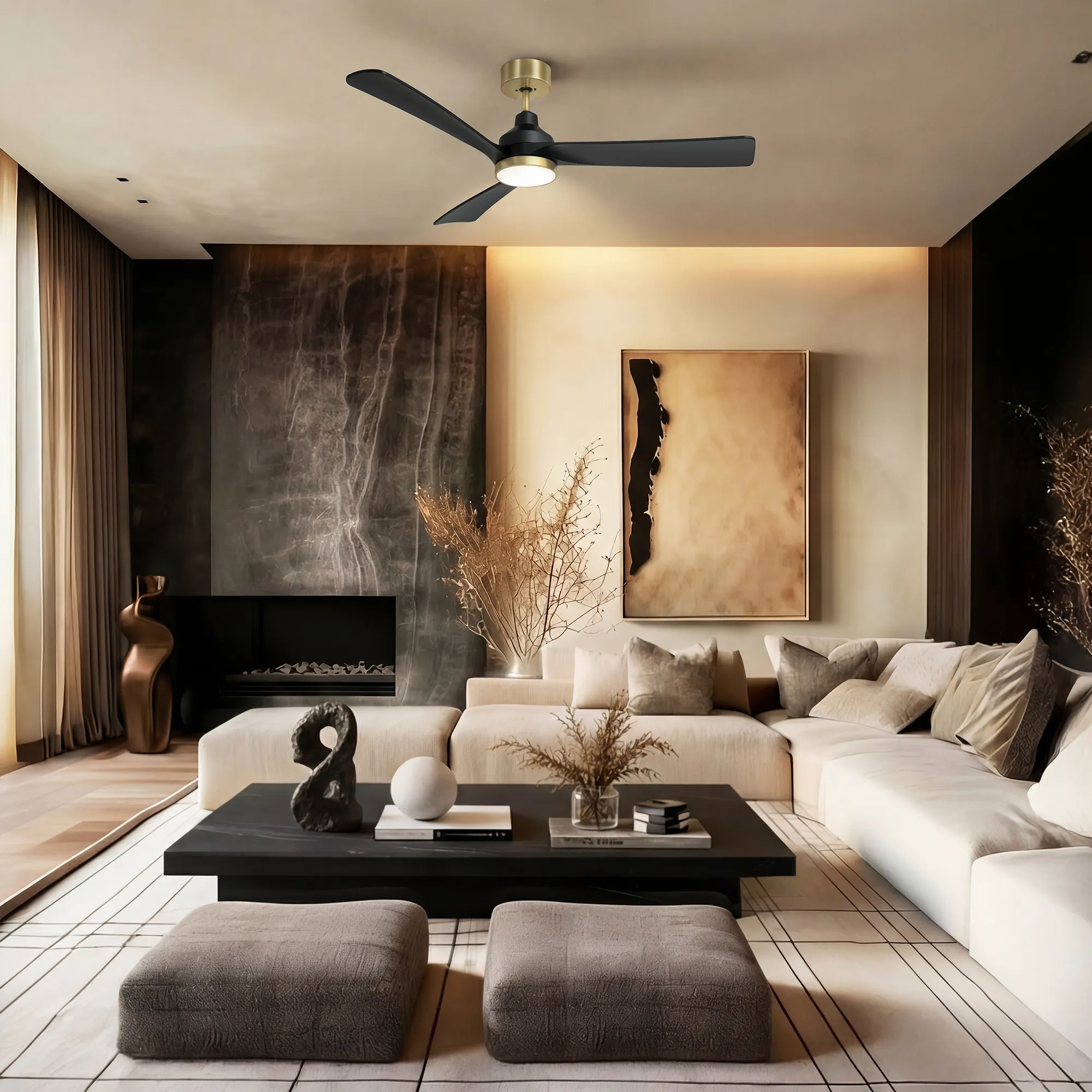
It’s one of the easiest traps to fall into: you see a fan light with a temptingly low price tag and think you've found a bargain. But this is a classic fan light buying mistake. Focusing only on the initial cost often means you’re overlooking the motor technology inside—and that’s where the real expenses are hiding.
If that cheap fan runs on an old-school AC (Alternating Current) motor, you're looking at a false economy. These models are notorious energy hogs, quietly driving up your electricity bill month after month.
Think of it like buying a car. You could grab the cheaper model with poor gas mileage, or you could invest a little more in a hybrid that saves you money at the pump over its lifetime. The smarter long-term investment is obvious. The same logic applies to fan lights; a modern DC (Direct Current) motor might cost a bit more today, but it pays for itself in energy savings.
The AC Motor Pitfall
AC motors are yesterday's technology. They’re built on a simple design, but they are incredibly inefficient by today's standards. An AC motor fan light can use up to 70% more electricity to generate the same airflow as a comparable DC model. This waste isn't just a number on a spec sheet—it's real money added to your monthly utility bills.
A cheap fan light can be one of the most expensive appliances you own if you only look at the purchase price. The true cost includes years of electricity consumption.
This isn't just about saving a few dollars, either. With energy regulations becoming stricter, inefficient appliances are on their way out. The global ceiling fan market is shifting dramatically toward high-efficiency models, with energy-saving BLDC (Brushless Direct Current) motors leading the charge. Buying an AC fan today is like buying technology that’s already being phased out.
When you're comparing your options, it's helpful to see the differences side-by-side.
AC vs. DC Motor Fan Lights: A Quick Comparison
This table breaks down why a small upfront investment in a DC motor fan pays off in the long run.
| Feature | AC Motor Fan Lights (The Trap) | DC Motor Fan Lights (The Smart Choice) |
|---|---|---|
| Energy Use | High consumption; can use up to 70% more electricity. | Ultra-efficient; sips energy, saving you money on every bill. |
| Operating Cost | Significantly higher long-term utility costs. | Dramatically lower electricity costs over the fan's lifespan. |
| Noise Level | Often produces a noticeable hum, especially at higher speeds. | Whisper-quiet operation, perfect for bedrooms and quiet spaces. |
| Speed Control | Limited options, typically just 3 speeds (Low, Medium, High). | Precise control with 6 or more speeds and a reverse function. |
| Features | Basic on/off functionality; limited smart home integration. | Often includes smart features, timers, and advanced remote controls. |
Choosing a DC motor fan isn't just an upgrade; it's a smarter, more cost-effective decision that delivers a better experience from day one.
How to Make a Cost-Effective Choice
To sidestep the AC motor fan light pitfalls, you need to look beyond the price. The key metric to hunt for is CFM per watt. This number tells you exactly how much airflow (in Cubic Feet per Minute) the fan produces for every watt of energy it consumes.
A higher CFM per watt rating means you get more breeze for your buck. It’s that simple. Here’s a quick comparison to put it in perspective:
- Standard AC Motor Fan: Might struggle to hit 75 CFM per watt.
- High-Efficiency DC Motor Fan: Can easily soar past 200 CFM per watt.
When you choose a fan light with a high CFM per watt rating, you're making an investment that pays you back with powerful, quiet cooling and lower utility bills. That's the real definition of a cost-effective fan light.
2. The Wrong Size and Airflow Mismatch
It’s one of the most common mistakes: you fall in love with the look of a fan light but completely ignore the size of your room. You find a sleek design and can instantly picture it hanging from your ceiling.
But here’s the reality: if that fan is too small for your room, it will spin without moving much air at all. You'll be left with the same stuffy feeling you were trying to escape. On the other hand, putting a massive fan in a tiny room creates a jarring, turbulent vortex that’s anything but comfortable.
The goal is a gentle, consistent breeze, not an indoor windstorm. Getting the size right from the start is the key to ensuring your new fan delivers the comfort you're paying for.
How to Match Fan Size to Your Room
Thankfully, this isn't guesswork. Before you start browsing, grab a tape measure and find your room’s square footage (just multiply its length by its width). That number is your guide for choosing the right blade span—the full diameter of the fan from blade tip to blade tip.
Here are the standard industry guidelines to match fan size to room size:
- Rooms up to 75 sq. ft. (e.g., small kitchens, home offices): Look for a blade span of 29 to 36 inches.
- Rooms from 76 to 144 sq. ft. (e.g., most bedrooms, dining areas): A span of 36 to 42 inches is your sweet spot.
- Rooms from 145 to 225 sq. ft. (e.g., standard living rooms): Choose a blade span between 44 and 52 inches.
- Rooms over 225 sq. ft. (e.g., great rooms, open-plan spaces): You’ll need a fan with a span of 52 inches or larger.
Don't Forget the Real Measure of Power: CFM
While blade span determines a fan's reach, the true measure of its cooling power is the CFM (Cubic Feet per Minute) rating. This number tells you exactly how much air the fan moves. A higher CFM means more powerful airflow, and it's a far more accurate performance indicator than motor size or the number of blades.
Ignoring CFM is a huge mistake that almost always leads to buyer's remorse. A beautiful fan with a weak CFM rating is little more than a spinning decoration.
A fan light's first job is to move air. Looks are important, but if it can't create a breeze, it's failing. Always check the CFM rating to make sure it’s up to the task.
Finding the Right CFM for Your Needs
So, how much CFM do you actually need? While it can vary based on ceiling height and personal preference, you can set some practical targets for a high-performing and cost-effective fan light:
- Bedrooms: Aim for 2,000 to 4,500 CFM. This range provides enough airflow to keep you cool without creating disruptive noise while you're trying to sleep.
- Living Rooms and Kitchens: As larger, high-traffic spaces, these rooms benefit from stronger circulation. Look for a CFM of 4,000 to 6,000 or even higher.
By focusing on both the correct blade span for your room’s square footage and a strong CFM rating, you can confidently pick a fan light that not only looks great but also keeps you comfortable.
3. The "Bargain" Fan with No Support
That shockingly low price tag on a fan light can feel like a huge win. But more often than not, it's hiding a slew of future expenses. One of the biggest fan light buying mistakes is focusing solely on the upfront cost, completely ignoring what that fan will really cost you over time. A "bargain" fan can quickly morph into a costly headache.
The hidden costs often start cropping up right away. For starters, many budget models are anything but all-inclusive, and you may need a professional electrician to install them safely. That's an expense many shoppers don't budget for. In fact, a 2023 market report pointed out that installation costs are a major source of buyer's remorse.
Where Manufacturers Cut Corners
To sell a fan for next to nothing, something has to give. Manufacturers of cheap fans almost always cut corners on the very components that make a fan light durable, quiet, and reliable. This means compromising on materials and build quality.
Here are the usual suspects where quality gets sacrificed:
- Low-Grade Motor Components: Instead of a well-engineered, balanced motor, you get cheaper parts that are practically guaranteed to hum, buzz, and vibrate.
- Flimsy Blade Materials: The blades might be made from thin materials that warp with humidity and time. The result? That dreaded, rhythmic wobbling and rattling that drives you crazy.
- Subpar Finishes: That beautiful finish can quickly chip, fade, or tarnish, making your new fan look old within months.
These compromises mean that while you save a little money today, you’re almost certainly signing up to buy a replacement much sooner than you think. A fan that dies after a year or two is no bargain at all.
The Hidden Cost of No Support
Beyond the physical hardware, another place budget brands skimp is on post-purchase support. A rock-bottom price often means you’re on your own the second you make the purchase. This is where the true value of a reputable brand shines.
A strong warranty and accessible customer support aren't just nice-to-haves; they are your insurance against defects and installation headaches. Think of them as essential parts of the investment.
When you're comparing fan lights, you need to ask some tough questions that go beyond the price:
- What is the warranty period? A short, restrictive warranty is a massive red flag. It’s the manufacturer telling you they don't expect their own product to last.
- Is customer support easy to reach? When you have a problem, you need to be able to talk to a real person.
- Are replacement parts available? A broken remote or a cracked light cover shouldn't force you to buy a whole new fan.
By looking past the sticker price, you can gauge the true value of what you're buying. This is how you choose a genuinely cost-effective fan light that will give you years of quiet, reliable performance.
The Three Types of Fan Lights to Always Avoid
Knowing the common pitfalls is half the battle. The other half is learning to spot a bad deal. No matter how tempting the price tag, some fan lights are practically guaranteed to cause headaches.
Let's walk through the three models you should always steer clear of, even if they look like a bargain.
1. The Energy-Guzzling AC Fan Light
This one is the most deceptive of the bunch. It might look sleek and modern, but under the hood, it's running on an old-school AC motor. Think of it as the gas-guzzler of the fan world.
These fans are energy vampires, sucking down far more electricity to produce less airflow than their modern DC counterparts. This is a classic AC motor fan light pitfall. What seems like a cheap purchase upfront quickly turns into an expensive drain on your monthly utility bills.
2. The "One-Size-Fits-Nowhere" Fan Light
You've probably seen this before: a fan that's comically tiny in a grand living room or one that's so massive it feels like a helicopter is landing in your bedroom. A huge fan light buying mistake is underestimating the link between room size and blade span.
A fan that's the wrong size just can't do its job right. It will either struggle to move any air at all or create a disruptive, turbulent wind tunnel. It's not just about airflow, either. You have to consider how the fixture’s style and brightness fit your space. Market analysis shows that homeowners are increasingly unhappy when a fan light clashes with their decor or doesn't provide the right kind of light.
3. The Bargain-Bin Fan with No Support
This is the fan with the unbelievably low price tag that seems too good to be true—because it is. It's often built with flimsy materials, a recipe for the dreaded wobbles and rattles that will drive you crazy.
Even worse, these fans usually come with a laughably short warranty (if any) and nonexistent customer support. When it inevitably breaks, you’re on your own. A truly cost-effective fan light isn't the cheapest one; it's the one built to last and backed by a company that stands behind its products for years to come.
To help you spot these problematic products, use this quick checklist. If a fan light you're considering ticks any of these boxes, it's a good idea to walk away.
Red Flag Checklist for Buying Fan Lights
Use this checklist to quickly identify low-quality fan lights and avoid making a purchase you'll regret.
| Red Flag Category | What to Watch Out For |
|---|---|
| Motor Type | No mention of a DC motor; only specifies "AC Motor" or is vague about the technology. |
| Certifications | Missing crucial safety certifications like cUPC, UL, or ETL listings. |
| Material Quality | Feels flimsy, lightweight, or has visible plastic seams; blades are thin and easily bendable. |
| Warranty & Support | Warranty is less than 5 years on the motor, or the manufacturer has no accessible customer service. |
| Sizing Information | Lacks clear guidance on what room size the fan is designed for (e.g., "for rooms up to 150 sq. ft."). |
| Lighting Specs | Vague details on lumens, Kelvin temperature, or dimmability; uses non-standard, hard-to-replace bulbs. |
| Customer Reviews | Multiple reviews mention excessive noise, wobbling, or difficult installation. |
Think of this checklist as your first line of defense. A quality manufacturer will be proud to display their certifications, warranty details, and performance specs. If that information is hard to find, it’s usually for a reason.
How to Choose a Fan Light You Will Love
We've covered the common mistakes, but let's pivot from what to avoid to what you should actively look for. The goal isn't just to dodge a bad purchase; it's to find a fan light you'll be genuinely happy with for years to come.
A truly cost-effective fan light is one that quietly and reliably keeps you comfortable, lights up your room beautifully, and doesn't send your energy bills soaring. It’s about getting real, lasting value. This means focusing on the three pillars of a fantastic fan light: a superior motor, the right size and airflow, and high-quality lighting.
This simple decision tree highlights the biggest pitfalls on your journey to the perfect fixture.
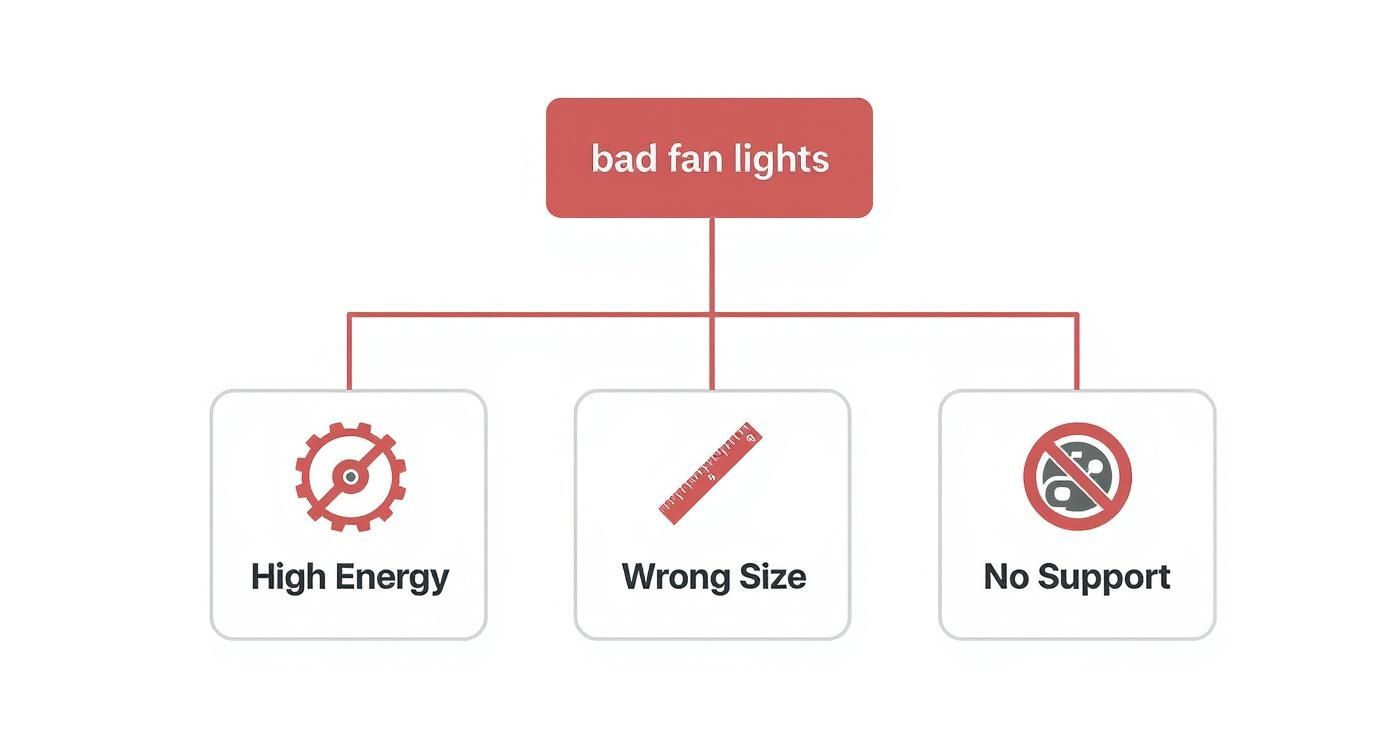
As you can see, getting the motor, size, or support wrong are the fastest ways to buyer's remorse.
Your Final Buying Checklist
Think of this as your last gut check before you buy. If you want a fan light that performs as good as it looks, make sure it ticks these boxes.
First, insist on a model with a modern DC (Direct Current) motor. These have become the gold standard for a reason. They run whisper-quiet, use a fraction of the energy, and give you far more precise speed control compared to their noisy, old-school AC counterparts.
Next, get the size right. Re-check your room’s dimensions and match them to the fan’s blade span and, most importantly, its CFM (Cubic Feet per Minute) rating. CFM is the real-world measure of how much air the fan actually moves. A good-looking fan that can’t create a breeze is just a decoration.
Finally, take a hard look at the light itself. Seek out integrated LED lights and find the specs for lumens (brightness) and Kelvin (color temperature). Good LEDs are not only incredibly efficient but also last for tens of thousands of hours, meaning you won't be climbing a ladder to change bulbs anytime soon.
A great fan light is more than just a fixture; it's a long-term investment in your home's comfort and ambiance. By focusing on a quality motor, correct sizing, and excellent lighting, you can make a smart, confident choice.
And for one final, non-negotiable check: look for proof of safety. Only consider products with independent safety certifications like UL or ETL listings. These marks are your assurance that the fan has passed rigorous testing for North American safety standards. It’s the ultimate peace of mind.
Got Questions? We've Got Answers
Even after doing your homework, a few questions can pop up. Let's tackle some of the most common ones we hear from shoppers, giving you the last few pieces of the puzzle to choose your fan light with total confidence.
What's the Right Height to Hang My Fan Light?
This is a big one, both for safety and for getting the most out of your fan. The golden rule is that the fan blades must hang at least 7 feet above the floor. This isn't just a suggestion; it's a standard safety code to make sure no one accidentally walks into them.
If your ceilings are taller than 8 feet, you'll almost certainly need a downrod. This brings the fan down to the sweet spot for air circulation, which is typically 8 to 9 feet from the floor. Always double-check the fan's specs to see what downrod lengths it supports and what's recommended for your specific ceiling height.
Does a Fan with More Blades Mean Better Airflow?
It’s a common assumption, but the answer is no, not really. The number of blades is much more about the fan's style and look than how well it moves air.
What truly matters for performance is the combination of motor power, the pitch (or angle) of the blades, and the fan’s overall aerodynamic design. A well-built three-blade fan with a modern DC motor can easily move more air than a clunky five-blade model with an outdated AC motor. So, instead of counting the blades, look for the CFM (Cubic Feet per Minute) rating—that's the real, unbiased measure of its cooling power.
How Many Lumens Do I Actually Need for My Room?
Choosing a light that's too dim is one of the easiest mistakes to make, and it can leave a room feeling gloomy. The brightness you need, measured in lumens, is all about the room's size and what you do in it.
Here’s a simple cheat sheet to get you started:
- Bedrooms & Living Rooms: For a cozy, inviting feel, look for something in the 1,500 to 3,000 lumen range.
- Kitchens & Home Offices: These are work zones that need clear, bright light. Aim higher, between 3,000 and 6,000 lumens.
- Bathrooms & Hallways: Smaller spaces don't need as much power; 500 to 1,500 lumens is usually plenty.
One non-negotiable feature? Dimming. A dimmable fan light gives you complete control, letting you go from bright, focused task lighting to a soft, relaxing glow with the touch of a button. It makes any room instantly more functional.
Ready to find a fan light that nails the details—from quiet performance and powerful airflow to stunning design? The curated collection at GreenEver features premium fixtures that are built to last and backed by a limited lifetime warranty. Find your perfect fan light today.


Leave a comment
This site is protected by hCaptcha and the hCaptcha Privacy Policy and Terms of Service apply.