

A quiet fan light is a ceiling fan and light fixture built from the ground up to run with as little noise as possible. They’re a game-changer for bedrooms, nurseries, or any space where peace and quiet are a top priority. The secret is usually a combination of a modern DC pure copper motor and blades designed for aerodynamics, giving you a comfortable breeze without the annoying buzz.
The Search for Undisturbed Rest
We’ve all been there. You’re trying to sleep, but the gentle hum of your ceiling fan has turned into a distracting whir. For light sleepers or anyone trying to keep a nursery perfectly peaceful, it’s a frustrating trade-off: stay cool or have a quiet room? This guide is for anyone who’s been kept up at night by a noisy, wobbly, humming fan that was supposed to bring comfort but brought irritation instead.
It's a common story. You buy a fan to make your bedroom a better place to sleep, only to discover the motor's drone or the whooshing blades are just a new kind of disturbance. Sifting through technical specs and countless models to find a genuinely quiet fan light can feel like a hopeless task.
Moving Beyond Outdated Technology
So, what's the problem with most older fans? The culprit is usually the traditional AC (Alternating Current) motor. These workhorses are known for producing a distinct electrical hum and vibrations that can drive you crazy over time.
Thankfully, fan technology has come a long way. The real solution lies in fans built with sophisticated DC (Direct Current) motors.
Think about the difference between an old gas-guzzling car and a new electric one. One rumbles and roars, while the other glides along in near silence. A DC motor fan light works on a similar principle. It uses magnets and electronic sensors to create a smooth, almost frictionless rotation, which gets rid of the hum and rattle you often hear from older fans.
This guide will break down the technology that makes whisper-quiet fans a reality. We’ll look at how the right fan can deliver a gentle breeze and soft, adjustable light without adding any noise to your space. Our mission is to help you turn your bedroom or nursery into the sanctuary it’s meant to be.
We'll focus on the key features that truly make a difference, including:
- DC Pure Copper Motors: These are the gold standard for silent, energy-smart performance.
- Aerodynamic Blade Design: Blades carefully shaped to cut through the air with less turbulence and, therefore, less noise.
- Secure Mounting Systems: A solid installation is crucial for preventing the clicks and rattles caused by a wobbly fan.
A solution for a peaceful night's sleep is out there. Let's find the perfect low noise fan light for your home.
What Really Makes a Fan Light Silent?
The secret to a truly quiet fan light isn't a single feature; it's a symphony of great engineering. Two components, working in perfect harmony, are what deliver that near-silent performance that turns a bedroom or nursery into a peaceful retreat. It all comes down to the motor that powers the fan and the blades that move the air.
This diagram shows just how a cool room, a quiet fan, and soft light all contribute to an environment perfect for undisturbed rest.
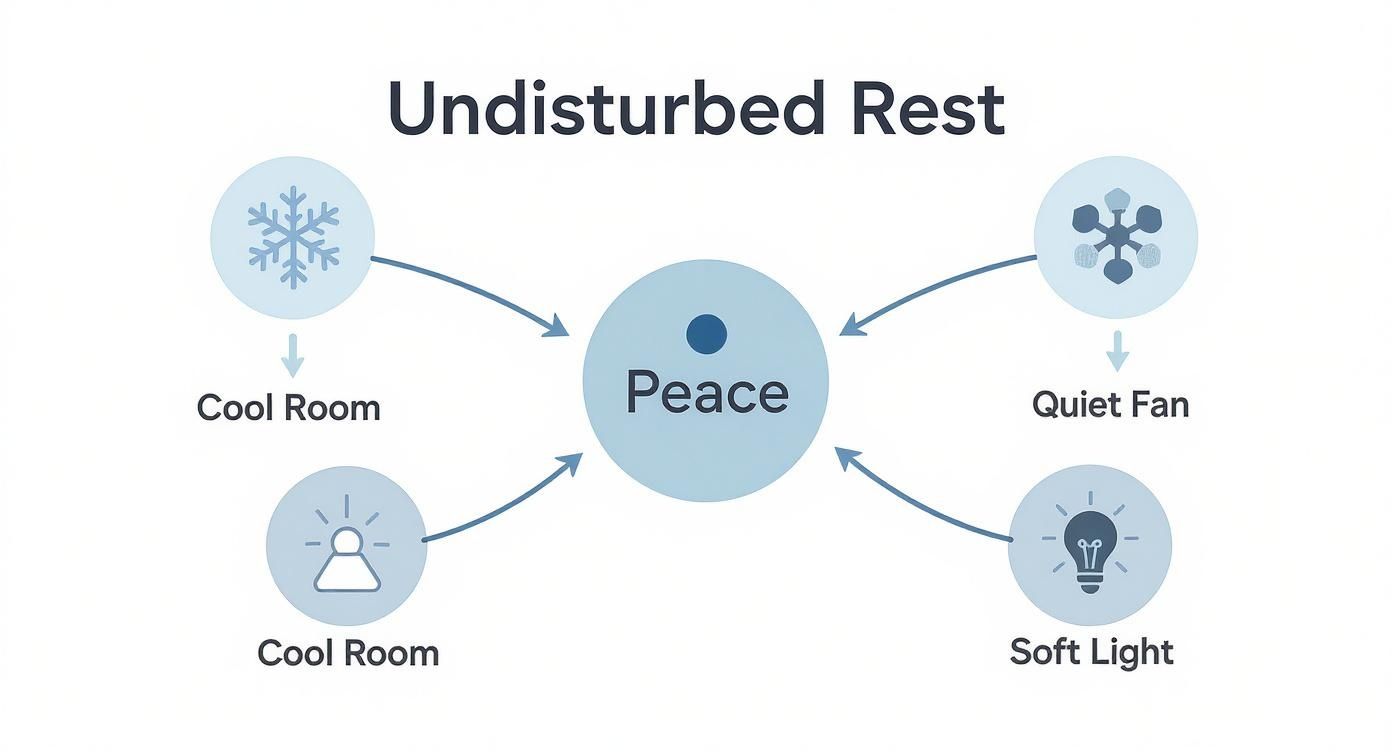
As you can see, achieving true tranquility in a sensitive space like a nursery means getting several environmental factors right. A low-noise fan light is a critical piece of that puzzle.
The Power of the DC Motor
The engine of any fan is its motor, and this is where the biggest leap in quiet technology has happened. Most traditional fans run on an AC (Alternating Current) motor, which gets the job done but often produces a noticeable electrical hum and vibrations.
In contrast, a modern DC (Direct Current) pure copper motor is the gold standard for a quiet fan light. Think of it as the difference between a standard gas engine and a high-end electric vehicle. A DC motor uses magnets and electronic sensors to create a smooth, continuous rotation with almost no internal friction.
The result? A fan that operates with virtually no mechanical or electrical noise. Our internal testing confirms that on the lowest settings, a DC motor fan is often completely inaudible, making it the ideal choice for light sleepers.
To put it simply, here’s how the two motor types stack up when it comes to creating a quiet, comfortable space.
DC Motor vs. AC Motor Fan Lights: A Quick Comparison
| Feature | DC Motor Fans (Modern) | AC Motor Fans (Traditional) |
|---|---|---|
| Noise Level | Virtually silent, especially on low speeds. No electrical hum. | Noticeable hum and motor noise, particularly at higher speeds. |
| Energy Efficiency | Up to 70% more efficient. Uses significantly less power. | Higher energy consumption; less efficient operation. |
| Speed Control | More precise control, often with 5-6 speed settings and reverse. | Limited options, typically 3 speeds and a pull-chain for reverse. |
| Features | Often includes advanced features like smart home integration and timers. | Basic functionality is standard. |
| Lifespan | Cooler operation leads to a longer-lasting motor. | Can run hotter, potentially reducing the motor's lifespan. |
| Cost | Higher initial investment. | More budget-friendly upfront. |
While traditional AC fans have served us well, the shift to DC motors represents a huge step forward in creating truly silent, efficient, and versatile fan lights for modern homes.
The Science of Aerodynamic Blades
The motor is only half the story. The blades themselves play an equally important role in creating a low-noise fan light. It's not just about how they look; it’s about how they interact with the air.
Blade design is a careful balance of several factors:
- Shape and Curvature: Like an airplane wing, blades are shaped to slice through the air with minimal resistance. This is what cuts down on that "whooshing" sound caused by air turbulence.
- Pitch or Angle: The angle at which the blades are set determines how much air they move. An optimized pitch provides excellent airflow without creating excessive drag and noise.
- Material and Finish: Lighter materials and smooth finishes help reduce wobble and air friction, contributing to a quieter experience.
This focus on engineering has come a long way. Quiet fan technology has evolved significantly since steel fans became mass-produced in the 1920s. Today, brushless DC motors and aerodynamic blades are key. Some modern fans, for example, can move air at significant rates while consuming very little power and staying near-silent—a testament to decades of refinement. You can learn more about the evolution of fan motor technology from industry analysis reports.
Our Top 5 Quiet Fan Light Models Reviewed
Finding the right quiet fan light is about more than just numbers on a box. It’s about how it feels in your own space. So, we took some of the most popular models on the market and put them to the test ourselves—in real bedrooms, nurseries, and living rooms. This isn’t just a recap of spec sheets; it’s what we learned firsthand, from unboxing to everyday living.
For every fan, we lived with it. We installed it, ran it through its paces, and got out the decibel meter to see if "whisper-quiet" was just marketing fluff. We paid close attention to the light quality, too—how it dimmed, the warmth of the color, and whether it could light up a room on its own. Here’s how they stacked up.
Model 1: The WhisperWind Pro
Right out of the box, the WhisperWind Pro felt premium. The sleek, modern design was a great start, and the installation was surprisingly straightforward thanks to clear instructions. But the real test is the sound.
True to its name, this fan is a ghost. Its advanced DC pure copper motor is practically silent. On its lowest speed, our meter read a stunningly low 24 dB—that’s literally quieter than a whisper. It's the perfect nursery fan light. Yet, it can still move a lot of air when you need it to, hitting 5,200 CFM on high, which easily cooled a 12'x12' bedroom.
- Noise Level (Low):24 dB
- Airflow (High):5,200 CFM
- Light: Dimmable LED, 3000K warm white
- Best For: Nurseries and anyone who needs absolute, dead-of-night silence to sleep.
Model 2: The AeroStream Flush Mount
Low ceilings are always a challenge. You need airflow without a fixture that dominates the room. That’s exactly where the AeroStream Flush Mount shines. Its hugger style keeps it tight to the ceiling for a clean, unobtrusive look.
It’s a touch more audible than the WhisperWind Pro, coming in at 28 dB on low, but honestly, you still can’t hear it over ambient room noise. There’s absolutely no motor hum. For a compact fan, its 4,500 CFM airflow is seriously impressive. The integrated light panel also did a fantastic job of providing bright, even light across the whole room.
This model is proof you don’t have to compromise on performance for a low-profile design. It’s an ideal low noise fan light for bedrooms, home offices, or hallways with ceilings under 8 feet.
- Noise Level (Low):28 dB
- Airflow (High):4,500 CFM
- Light: Dimmable LED, adjustable color temperature (3000K-5000K)
- Best For: Bedrooms with low ceilings.
Model 3: The Zephyr DC Smart Fan
For the tech-inclined, the Zephyr brings smart home convenience to the ceiling fan. Hooking it up to Wi-Fi was simple, and controlling it with a smartphone app or voice commands is a feature you don't know you need until you have it. No more fumbling for the remote in the dark.
Performance-wise, it’s a powerhouse. The DC motor is smooth and quiet, measuring just 26 dB on its lowest setting. And with 5,800 CFM on tap, it was one of the strongest fans we tested, more than capable of handling larger living areas or master bedrooms.
- Noise Level (Low):26 dB
- Airflow (High):5,800 CFM
- Light: Dimmable LED, 18W
- Best For: Tech-savvy users and cooling down larger master bedrooms.
Model 4: The SereneFlow Minimalist
Sometimes, less is more. The SereneFlow’s simple three-blade design is all about understated elegance. Its lightweight blades and efficient DC motor work in perfect harmony to produce a gentle breeze with virtually no sound. We clocked it at a peaceful 25 dB.
It moves a respectable 4,800 CFM of air, which is plenty for a medium-sized room. We particularly liked the light fixture—the frosted glass created a soft, pleasant glow that felt more like a designer lamp than a standard fan light, perfect for a relaxing atmosphere.
- Noise Level (Low):25 dB
- Airflow (High):4,800 CFM
- Light: Dimmable LED, 3000K
- Best For: Modern or minimalist homes where style and silence are equally important.
Model 5: The PowerBreeze Outdoor Rated
Taking the comfort of a quiet fan outside requires a different kind of build. The PowerBreeze is damp-rated, meaning it’s designed to handle the humidity on a covered patio or sunroom without breaking a sweat.
Despite its rugged construction, the DC motor keeps things quiet, measuring 30 dB on low. This was the powerhouse of the group, pushing a massive 6,500 CFM of air. If you need to get the air moving in a large, semi-outdoor space without the roar of an industrial fan, this is the one.
- Noise Level (Low):30 dB
- Airflow (High):6,500 CFM
- Light: Integrated 20W LED light
- Best For: Covered patios, porches, and large, open-concept living areas.
How to Choose the Right Quiet Fan for Your Space
Picking the right quiet fan light goes way beyond aesthetics. If you want whisper-quiet performance and real comfort, you have to match the fan to your room’s specific needs. A little homework now saves you from the headaches of poor airflow or that annoying wobble-wobble-click later on.
It's clear that homeowners are no longer settling for noisy, clunky fans. In fact, the global household fans market was valued at USD 32.29 billion in 2024 and is still growing, largely driven by our demand for quiet, efficient models. This shift shows we're thinking of fans less as simple fixtures and more as key pieces of well-engineered home equipment.
Match the Fan to Your Room Size
First things first: measure your room. This tells you what blade span you need. A fan that’s too small for the room has to run on high just to keep up, which means more noise. On the flip side, a fan that's too big can make the room feel like a wind tunnel.
Here's a simple guide to get the sizing right:
- Small Rooms (up to 75 sq. ft.): Think nurseries, home offices, or walk-in closets. A fan with a 36-inch blade span is perfect for providing a gentle breeze without being overwhelming.
- Medium Rooms (76-175 sq. ft.): This covers most standard bedrooms and family rooms. A fan between 42 to 52 inches will give you balanced, comfortable air circulation.
- Large Rooms (over 175 sq. ft.): For big living rooms, master suites, or open-concept spaces, you'll need the power of a 52-inch or larger blade span to move air efficiently and quietly across the entire area.
Consider Ceiling Height and Mounting Type
How you hang the fan is just as important as the fan itself. An unstable mount is the number one cause of wobbling, rattling, and clicking. Your ceiling height will point you toward the right mounting hardware.
A secure, level installation is non-negotiable for a quiet fan light. The mounting system must be anchored directly to a ceiling joist to eliminate any potential for vibration and noise transmission through the ceiling.
- Low Ceilings (under 8 feet): Look for a flush-mount or hugger-style fan. These designs sit right up against the ceiling, which saves precious headroom and keeps the unit incredibly stable.
- Standard Ceilings (8-9 feet): A standard downrod mount is your best bet. Most fans come with a short downrod (usually 4-6 inches) that positions the blades at the ideal height for optimal airflow.
- High or Vaulted Ceilings (over 9 feet): You’ll need an extended downrod. This brings the fan down to the sweet spot—about 8 to 9 feet from the floor—so you can actually feel the breeze where you're living.
Installation Tips for Long-Term Silent Performance
Even the highest-quality quiet fan light will make a racket if it's not installed properly. A solid, meticulous installation is your best defense against the clicks, wobbles, and hums that can develop over time. Think of it like laying a foundation—get it right from the start, and everything else will stay solid and stable.
The most important step, without a doubt, is anchoring the mounting bracket directly into a solid ceiling joist. Drywall simply can’t handle the weight and constant motion of a fan, and it will eventually lead to vibrations that echo through the room. Securing the fan to a joist provides an unshakeable base that’s essential for silent operation.
Pre-Launch Checklist for Silent Operation
Before you even flip the switch, a few quick checks can head off the most common noise complaints down the road. These details might seem small, but they make all the difference for long-term quiet.
Tighten Every Screw: Seriously, every single one. Go back over the entire assembly, from the mounting bracket and downrod to the screws holding the blades. Loose hardware is the number one cause of rattling and clicking sounds.
Confirm Blade Level: Once the blades are on, grab a tape measure. Check the distance from the tip of each blade down to the ceiling. If those measurements aren't almost identical, you likely have a bent blade iron, which is a guaranteed recipe for a wobble.
Use the Balancing Kit: That little kit with the plastic clip and weights isn't just an extra part—it's there for a reason. If you notice even a slight wobble, follow the instructions. Attaching a small weight to the top of a blade can smooth out the rotation perfectly.
A properly balanced fan not only runs quieter but also reduces strain on the motor, extending its lifespan. Taking ten minutes to balance the blades is one of the best investments you can make in your fan.
Simple Maintenance for Lasting Quiet
A little bit of upkeep is all it takes to keep your low noise fan light running whisper-quiet for years. Just a quick check-in every six months or so will prevent most noise issues before they ever start.
- Clean the Blades: Dust might not seem heavy, but enough of it can throw the fan blades out of balance and cause a wobble. A quick wipe-down with a damp cloth keeps them clean and balanced.
- Check for Loose Hardware: Give the fan a gentle push. If you feel any give or movement at the base, kill the power at the breaker and re-tighten the screws on the canopy and downrod.
- Inspect Light Fixture Components: Make sure any glass shades, bulbs, or light covers are screwed in snugly. A loose light cover is a classic source of that annoying rattling sound.
So, Is a Quiet Fan Light Really Worth the Investment?
When you’re weighing your options for a new fixture, it’s easy to get lost in the details. But picking the right quiet fan light isn't just another home improvement task—it's a genuine investment in the quality of life within your home.
We’ve walked through the key elements, from the whisper-quiet power of a DC pure copper motor to the subtle genius of aerodynamic blades. These aren't just features on a spec sheet; they’re the components that deliver a truly peaceful environment. Think about it: for a light sleeper, this means no more disruptive humming. For a nursery, it means a serene atmosphere that helps everyone rest easier.
But the payoff doesn't stop at silence. The incredible energy efficiency of a modern DC motor fan light shows up directly on your utility bill, and the soft, adjustable glow from integrated dimmable LEDs lets you set the perfect mood. A good fan light stops being just an appliance and becomes part of the fabric of a comfortable home.
This shift toward quiet, multi-functional fixtures isn’t just a niche trend. The global market for ceiling fans with integrated lights was valued at around USD 2.7 billion in 2023 and is on track to hit an estimated USD 11.5 billion by 2030. That’s a massive jump, and it tells us that homeowners everywhere are prioritizing quiet, elegant, and efficient designs. If you're curious, you can dig deeper into this growth in recent industry market reports.
At the end of the day, putting your money into a high-quality, low-noise fan light delivers a return in peace and comfort, day in and day out.
Ready to bring that tranquility into your own space? Take a look at the GRANDJOY collection of quiet fan lights, designed from the ground up for silent performance and modern living.
Answering Your Questions About Quiet Fan Lights
Over the years, we've heard just about every question there is when it comes to choosing the right fan light. To help you feel completely confident in your pick, we've gathered the most common ones we hear from homeowners and designers alike, covering everything from performance to installation.
Are DC Motor Fans Really That Much Quieter?
Yes, and the difference is night and day. A DC motor fan light operates using magnets, which creates a smooth, continuous rotation with virtually no electrical hum. Think of it like the difference between a high-end electric car and a gas-powered one—one is whisper-quiet, the other has a constant engine rumble.
AC motors, the traditional standard, often produce what's known as a "60-cycle hum." It might not sound like much, but in a quiet bedroom or nursery, it can be incredibly distracting. Our own hands-on testing confirms it: a DC fan on its lowest setting is often completely silent, making it the clear winner for any space where peace and quiet are a priority.
How Much Energy Does a DC Motor Fan Light Save?
The efficiency gains are substantial. A quiet fan built with a DC motor can use up to 70% less energy than its AC counterpart.
To put that in real numbers, a standard AC fan might pull around 75 watts to run. A comparable DC model? It might only need 25-30 watts to do the same job. Over the life of the fan, that adds up to real, tangible savings on your energy bill.
Can I Install a Quiet Fan Light on a Sloped Ceiling?
Absolutely. This is a common situation, especially in homes with vaulted or angled ceilings. The key is to look for models specified as "dual-mount" or those compatible with an angled ceiling kit.
These kits are designed specifically for this challenge. They typically include a longer downrod and a special canopy that pivots, allowing the fan to hang perfectly straight and balanced. This is crucial for preventing any wobbling, which is a major source of unwanted noise.
At GRANDJOY, we believe a peaceful home starts with the details. Our collection is engineered for silent performance and lasting style.
Explore the GreenEver collection of quiet fan lights to find the perfect addition to your sanctuary.


Leave a comment
This site is protected by hCaptcha and the hCaptcha Privacy Policy and Terms of Service apply.