

Ever found yourself stumbling in the dark for a pull chain or wishing you could adjust the fan speed without getting out of bed? That’s precisely the problem a voice control fan light solves. It’s a beautifully simple concept: a modern ceiling fixture that combines a fan and a light, all controlled by the sound of your voice through a smart home assistant.
Understanding the Modern Ceiling Fan
At its heart, a voice control fan light is a traditional ceiling fan that's been given a serious tech upgrade. By connecting to your home's Wi-Fi network, it can listen and respond to commands from voice assistants like Amazon Alexa or Google Assistant. This wireless connection is the magic that translates a simple spoken request into an immediate action, like turning up the fan or dimming the lights.
It’s a bit like upgrading from a basic flip phone to a smartphone. Both make calls, but one opens up a world of effortless, integrated convenience. Instead of fumbling for a remote that’s slipped between the couch cushions, you just speak.
The Key Components of Control
Getting this to work seamlessly involves three pieces of technology working together perfectly:
- The Smart Fixture: The fan light itself has a built-in Wi-Fi receiver, which is constantly ready to receive commands from your network.
- Your Voice Assistant: This is the "ears" of the system—a smart speaker like an Echo Dot or your phone—that listens for your command.
- The Cloud Service: Think of this as the digital brain. It interprets what you said and sends the correct instruction back to the fan almost instantly.
This trio allows for incredibly specific control. You can say, "Hey Google, set the fan to 50 percent," or "Alexa, change the light to warm white," and the fixture responds on cue. This hands-free operation is the number one reason these fixtures are becoming so popular.
A Rapidly Expanding Market
This desire for integrated convenience isn't just a niche trend; it's driving a major shift in the home fixture market. The global smart ceiling fan market is experiencing significant growth, reflecting a clear sign that homeowners are embracing smart technology that blends everyday comfort with real efficiency. As voice commands become a standard expectation, not a luxury, the market is poised for even more growth. You can discover more insights about this growing market to see just how fast things are changing.
Before we dive deeper into compatibility and features, let's quickly summarize why these fixtures are such a compelling upgrade.
Key Benefits of a Voice Control Fan Light
This table breaks down the main advantages of switching to a voice-controlled fan light, giving you a quick look at the practical, day-to-day benefits.
| Feature | Description of Benefit | Example Use Case |
|---|---|---|
| Hands-Free Operation | Control your fan and light without physical touch. Perfect for when your hands are full or you're relaxing. | "Alexa, turn on the kitchen fan" while you're cooking with messy hands. |
| Enhanced Accessibility | Makes it easier for individuals with mobility challenges or children to adjust room comfort and lighting. | A person in a wheelchair adjusting the fan speed without needing assistance. |
| Precision Control | Fine-tune fan speeds and light brightness to exact percentages, rather than just high, medium, or low settings. | "Hey Google, set the living room light to 20 percent" for movie night. |
| Smart Home Integration | Connects with other smart devices to create automated routines (e.g., "Goodnight" scene turns off lights and fan). | Setting a routine where the fan turns on automatically when the room hits 75°F. |
| Energy Efficiency | Schedule fans and lights to turn off when you're not home, reducing wasted electricity and lowering utility bills. | "Siri, turn off the bedroom fan in 30 minutes" as you're falling asleep. |
As you can see, the benefits go far beyond just novelty. They offer genuine improvements in convenience, accessibility, and even energy savings, making them a smart investment for any modern home.
How These Smart Fans Fit Into Your Home
So, how does a voice control fan actually work? It connects to your home much like any other smart device, whether it's a smart speaker or a thermostat—it just needs your home's Wi-Fi network.
Think of the fan's built-in Wi-Fi module as its ears. When you say something like, "Hey Google, turn on the fan," that module receives the instruction from your smart assistant and tells the fan what to do. It all happens in a flash, making it feel like a seamless conversation between you and your home.
The diagram below breaks down this simple three-step flow.
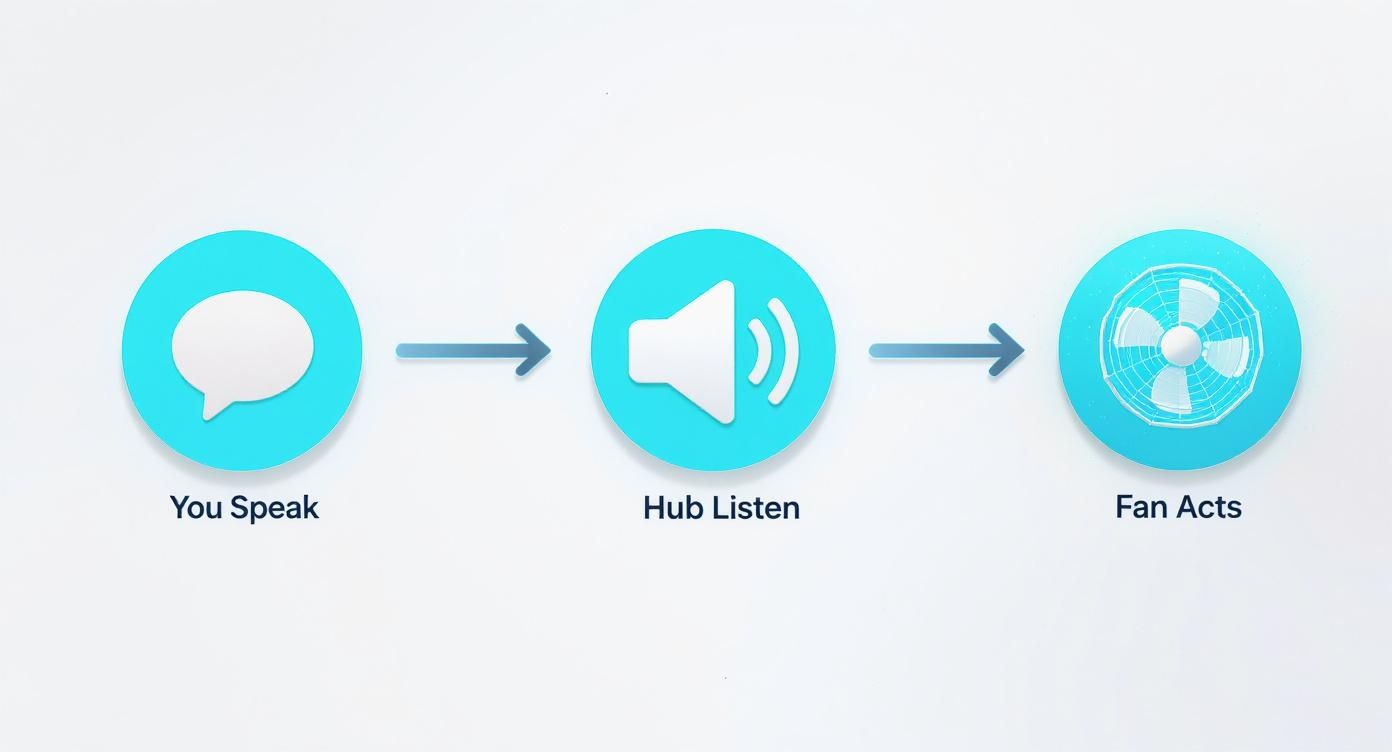
As you can see, your command goes to the smart hub, which then directs the fan—all in just a few seconds. The fan essentially becomes another smart device you can manage right from your central smart home app, just like a smart TV or plug.
The Initial Setup Process
Getting your new fan online is refreshingly simple. While you should always follow the manufacturer's specific directions, the basic steps are usually the same.
- Install the Manufacturer's App: The first thing you'll do is download the fan brand’s app on your phone. This app is your command center for the initial setup.
- Connect to Your Wi-Fi Network: Next, the app will guide you through connecting the fan to your home’s 2.4 GHz Wi-Fi network. This is the critical step that gets the fan online and ready to communicate.
- Link to Your Voice Assistant: Finally, you'll pop over to your Amazon Alexa or Google Home app. Here, you'll enable the manufacturer's "skill" or "action," which authorizes your smart speaker to find and control the fan.
Once everything is linked, it's smart to give your fan a unique, easy-to-remember name. Calling it "Bedroom Fan Light" instead of a generic "Fan 1" makes voice commands feel far more natural and prevents mix-ups with other devices.
Creating Advanced Smart Routines
The real magic happens when you go beyond basic commands and weave your fan into smart home routines. These are custom sequences where multiple devices work together, triggered by a single phrase, a specific time, or even a sensor.
Imagine creating a "Wind Down" routine for your evenings. Just by saying, "Alexa, start Wind Down," you could have your bedroom lights dim to 30% brightness, the fan switch to a gentle, low speed, and a smart speaker start playing quiet music. This is where a simple fixture becomes an integral part of making your home more comfortable and intuitive.
What Really Makes a Smart Fan "Smart"?
When you start shopping for a voice-controlled fan light, it's easy to get the impression they're all basically the same. But once you get past the simple "turn on/off" commands, you'll find a world of difference between a basic model and a truly premium fixture. The best ones offer a whole suite of features that let you fine-tune your room's comfort, mood, and efficiency.
Forget the old high, medium, and low settings. A top-tier smart fan gives you much more precise control. Look for models with multi-level fan speeds that let you dial in the exact airflow you want. Being able to say, "Alexa, set the fan to 40 percent," means you can get a gentle, whisper-quiet breeze instead of a full-on gale.
It's All About the Light and Ambiance
The "light" in a voice control fan light is just as crucial as the fan itself. The best fixtures do more than just illuminate a room; they help create the perfect atmosphere for any time of day.
Here are the lighting features that really matter:
- Smooth Dimming Capabilities: The ability to adjust brightness from a subtle 1% to a full 100% is a must. This lets you go from bright, focused light for cooking to a soft, relaxing glow for winding down in the evening.
- Adjustable Color Temperature: This is a real game-changer. It allows you to shift the light from a crisp, cool white (around 5000K) that helps you wake up, to a warm, cozy yellow (around 2700K) that's perfect for relaxing before bed.
- Dedicated Light and Fan Control: Make sure your smart assistant can see the light and fan as two separate devices. This simple but critical feature prevents you from turning the fan on every time you just want to turn on the light.
With these controls, your fan light becomes an integral part of your home’s lighting design, not just another utility.
Automation, Efficiency, and the Magic of a Great Motor
This is where the real intelligence of a smart fan shines through. Automation—the ability to create schedules and routines—is what transforms it from a convenience into an energy-saving powerhouse. You can set the fan to turn off after you leave for work or have the lights slowly dim as you get ready for sleep.
A huge part of this efficiency comes down to the motor. The best modern smart fans are built with DC (Direct Current) motors, which are often up to 70% more energy-efficient than the old-school AC motors you find in traditional fans.
This upgrade in motor technology is massive. DC motors don't just use less power; they also run cooler and are incredibly quiet. That near-silent operation makes them perfect for bedrooms, nurseries, or home offices where the constant hum of a standard fan would be a major distraction.
When you put it all together, the quiet performance and serious energy savings make a DC motor one of the most important upgrades you can get. Focusing on these core features ensures you're not just buying a gadget, but investing in lasting comfort and smarter living.
Choosing the Right Design for Your Space
A voice control fan light is so much more than a functional appliance—it's a statement piece, a focal point that can pull an entire room together. The trick is to find that perfect balance where smart technology meets your home’s unique aesthetic. The goal isn't just to find a fan that works well, but one that genuinely elevates your decor, whether you’re aiming for a sleek modern vibe, a cozy traditional feel, or something entirely your own.
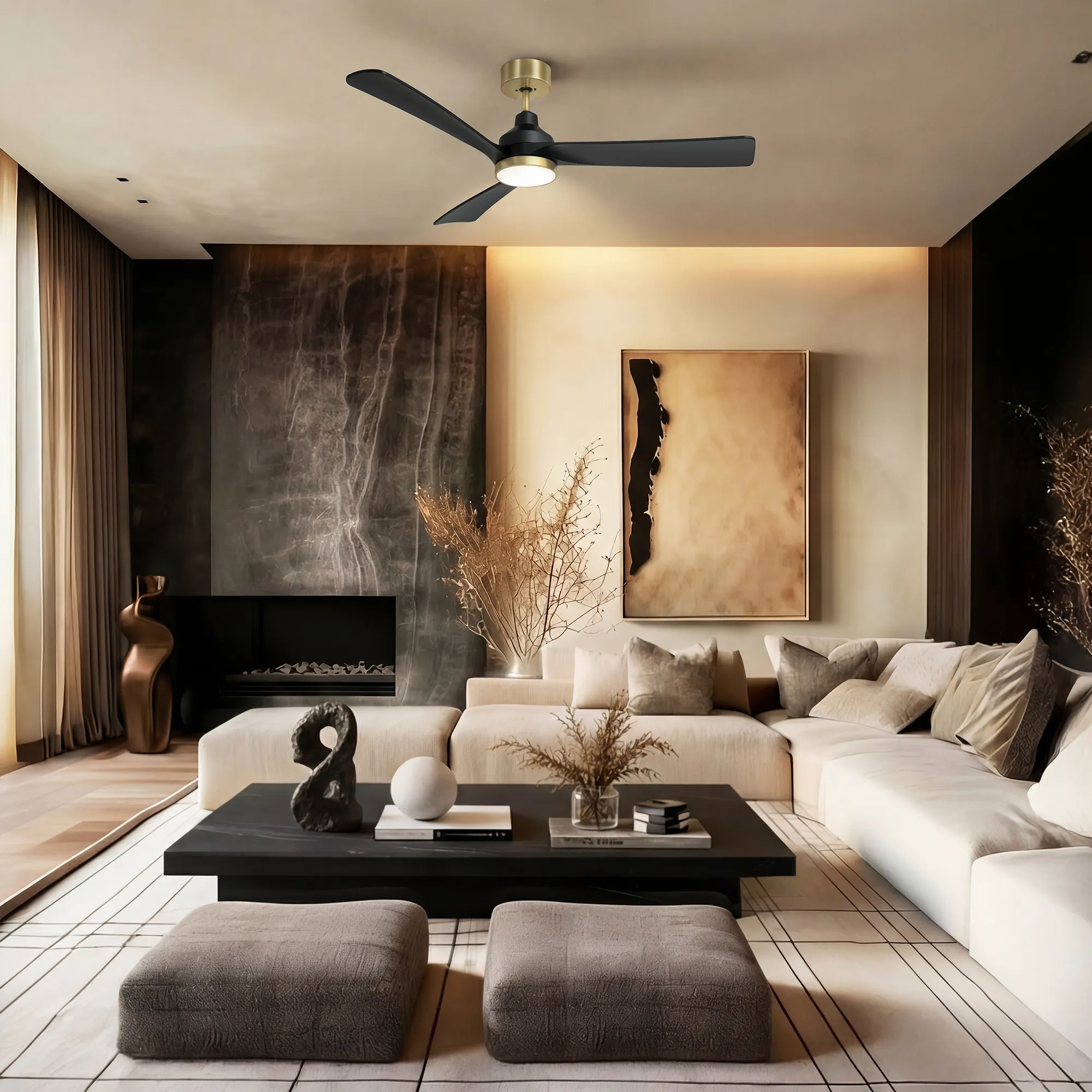
This blend of high-end decor and smart functionality is a major global trend. This blend of high-end decor and smart functionality is a major global trend. What’s driving that growth? People want premium home decor that also includes smart features like voice commands and stylish, customizable blades. What’s driving that growth? People want premium home decor that also includes smart features like voice commands and stylish, customizable blades.
Matching the Fan to Your Room Size
Before you get swept away by a stunning design, let's talk about the practical stuff. The single most important factor for performance is getting the size right for your room. This is what ensures you get a gentle, consistent breeze instead of a wind tunnel effect—or worse, a fan that barely moves the air at all.
There are two numbers you need to know:
- Blade Span: This is the measurement from the tip of one blade to the tip of the blade directly across from it. Bigger rooms need a wider blade span to circulate air properly.
- CFM (Cubic Feet per Minute): This tells you how much air the fan moves. A higher CFM means more power, which is great for large spaces or rooms with vaulted ceilings.
Getting these right is the foundation for a comfortable and efficient room. To make it simple, here's a quick guide to help you choose the right blade span.
Use this guide to match the fan's blade span to your room's dimensions, ensuring effective and efficient air circulation.
Fan Size Recommendations for Optimal Airflow
| Room Size (Square Feet) | Recommended Fan Blade Span (Inches) | Ideal For |
|---|---|---|
| Up to 75 | 29 – 36 | Bathrooms, walk-in closets, laundry rooms |
| 76 – 144 | 36 – 44 | Bedrooms, home offices, small kitchens |
| 145 – 225 | 44 – 52 | Living rooms, master bedrooms, kitchens |
| 226 – 400 | 52 – 60 | Great rooms, large living areas, lofts |
| Over 400 | 62+ | Open-concept spaces, vaulted ceilings |
Once you’ve nailed down the right size, you’re ready for the best part.
Finding the Perfect Aesthetic Fit
Now you can focus on style. The materials and finishes of your fan are what will make it feel like a natural part of your home. A fan with sharp, matte black blades can make a bold, contemporary statement, while another with warm wood tones can add an organic, inviting touch.
Think of your fan as a piece of functional sculpture for your ceiling. Finishes like brushed nickel, polished chrome, or oil-rubbed bronze can connect the fixture to other hardware in the room—like cabinet handles or faucets—for a beautifully cohesive look.
By thinking about both performance and style, you can pick a voice control fan light that’s not just smart, but a true centerpiece that makes your whole space feel more intentional and complete.
A Word on Installation and Safety
Bringing a smart fan light into your home is a fantastic upgrade, but let's talk about what happens before you ever say, "Alexa, turn on the fan." Getting the physical installation right is the most critical step, and it all comes down to working safely with your home's electrical wiring.
Most of these fans run on a standard 120V electrical circuit, which is what you’ll find in almost any modern home. The real key, though, is the electrical box in your ceiling. It absolutely must be fan-rated. Think about it—a fan is a heavy, moving appliance. A standard light fixture box isn't built to handle that weight and vibration, making a fan-rated box a non-negotiable safety requirement.
To DIY or Call in a Pro?
So, can you install it yourself? Maybe. If you're replacing an existing ceiling fan and you're already comfortable with basic home electrical work—like shutting off the power at the breaker and connecting color-coded wires—you might be up for the task.
However, there are times you should absolutely hire a licensed electrician. Don't even think about tackling it yourself if:
- You're putting a fan where there was no fixture before.
- Your home has older wiring, or you have any doubt about the ceiling box being fan-rated.
- The job requires running new wires or adding a new wall switch.
An electrician doesn’t just get the job done; they ensure it’s up to local building codes, which brings a level of peace of mind you just can't put a price on. Professional installation costs can vary widely depending on the complexity of the job.
Don't Skip the Safety Certifications
When you're comparing different smart fans, it’s easy to get caught up in the features and forget about the foundational stuff. But please, don't overlook the safety certifications. Look for official marks from Nationally Recognized Testing Laboratories (NRTLs) on the box or in the product specs.
In North America, the two big ones you'll see are UL (Underwriters Laboratories) and ETL (Intertek). Seeing one of these logos means the fixture has been put through its paces and passed stringent tests for electrical safety and solid construction.
These certifications are your guarantee that the product is built to prevent fire or shock hazards. It’s a must-have for any electrical appliance, especially one that’s permanently installed in your ceiling. Opting for a certified product confirms you're buying a quality item that was built with your safety as the top priority.
Solving Common Voice Command Problems
Even the best smart technology hits a snag every now and then. When your voice control fan light suddenly decides to ignore you, it’s usually not a sign of a major problem. More often than not, it's a simple communication hiccup that's easy to fix.
The first place to look? Your Wi-Fi network. Smart devices are only as smart as their connection, and an unstable signal is the number one cause of unresponsiveness. A quick reboot of your router and the fan itself (just flip the circuit breaker off for a minute, then back on) can work wonders to re-establish that connection.
This kind of connectivity is exactly why the smart appliance market has taken off. This kind of connectivity is exactly why the smart appliance market has taken off. A huge part of that is because people love the sheer convenience of controlling their home with their voice or an app. It’s also driven by advancements like whisper-quiet, energy-sipping DC motors. A huge part of that is because people love the sheer convenience of controlling their home with their voice or an app. It’s also driven by advancements like whisper-quiet, energy-sipping DC motors.
Diagnosing Command Confusion
What if the fan does respond, but gets it wrong—turning on the fan when you clearly asked for the light? This isn't a glitch; it's a mix-up in how your voice assistant understands the device. The fix is usually in the naming.
Think of it like this: if you have two colleagues named Chris in your office, you'd use their last names to avoid confusion. Your voice assistant needs the same clarity.
Give your fan and light components distinct, easy-to-say names in your smart home app. "Master Bedroom Fan" and "Master Bedroom Light" are far less ambiguous than a generic label like "Ceiling Fixture 1."
If you’re still having trouble, run through this quick checklist:
- Check the App: Pop open your Alexa or Google Home app. Do you see two separate, controllable devices for the fan and the light? If not, there's your problem.
- Use Specific Commands: Get right to the point. Instead of a vague "turn on the bedroom fixture," try a direct command like, "Hey Google, turn on the bedroom light."
- Sync Your Devices: Sometimes your voice assistant just needs a refresh. Simply say, "Alexa, sync my devices," to make sure it has the latest setup information.
Running through these simple steps will solve the vast majority of voice command issues, getting you back to the effortless, hands-free control you wanted from your voice control fan light in the first place.
Common Questions, Answered
Thinking about adding a voice control fan light to your home? You're not alone. Let's walk through some of the most common questions we hear from homeowners to clear things up and help you make a confident choice.
Can I Still Use a Wall Switch or Remote?
Absolutely. Every good smart fan light is designed with multiple control options in mind. You'll almost always get a dedicated remote, and the standard wall switch will still turn the fixture on and off. You’re never locked into just one method.
There's one small catch, though. For the voice commands and smart features to work, the wall switch has to stay in the "on" position. This keeps the fan's smart receiver powered up and connected to your Wi-Fi, ready to listen for your commands.
Do I Need a Special Smart Home Hub?
In most cases, no. The beauty of today's voice-activated fans is that they connect directly to your home’s Wi-Fi network. You don’t need an extra piece of hardware like a Zigbee or Z-Wave hub cluttering up your space.
These fans are built to talk directly with cloud services from Amazon Alexa or Google Assistant. Just double-check the product specs before you buy to make sure it plays nicely with the smart home system you're already using.
Key Takeaway: While you probably won't need a hub, a stable 2.4 GHz Wi-Fi signal in the room is non-negotiable. It's the lifeline that allows your fan to reliably hear and respond to your voice commands.
What Happens If My Internet Goes Down?
If your internet connection drops, you'll temporarily lose the "smart" part of your fan. Voice commands and app controls won't work because your smart speaker can't reach the fan's receiver over the network.
But don't worry—you won't be left in the dark or without a breeze. You can always fall back on the physical remote control or the wall switch for basic fan and light functions. Once your internet is back online, all the smart features will reconnect automatically.
Ready to experience this blend of convenience and modern style for yourself? The GRANDJOY collection features premium, certified fixtures designed to integrate beautifully into your smart home. Explore our voice control fan lights today and find the perfect upgrade for your space.


Leave a comment
This site is protected by hCaptcha and the hCaptcha Privacy Policy and Terms of Service apply.