

When you’re looking for the best kitchen faucet with sprayer, you’re searching for more than just a tap. You want a practical combination of durable, low‑lead materials, versatile spray functions, and a design that fits how you actually use your kitchen. It should provide a gentle aerated stream for filling pots and rinsing produce, plus a powerful spray for cleaning, all backed by recognized certifications and a warranty you can trust.
Why Your Kitchen Faucet Is the Heart of Your Kitchen
Cabinets, countertops, and appliances often steal the spotlight in a kitchen design, but the faucet is usually the fixture you touch most often. You rely on it for rinsing vegetables, washing your hands, filling pots for cooking, and cleaning dishes throughout the day. A poorly performing faucet—weak spray, a hose that won’t retract, or a finish that wears quickly—can turn simple tasks into repeated frustrations.
Kitchen faucets have evolved from basic, single‑function taps into multi‑purpose tools. Today’s integrated sprayers replace many older, separate side sprayers and deliver targeted cleaning exactly where it’s needed. Choosing the right faucet is not just about appearance; it’s an investment in your kitchen’s daily function and long‑term convenience.
This guide explains what separates an average faucet from a great one so you can confidently choose the best kitchen faucet with sprayer for your home.
Pull‑Down, Pull‑Out, or Semi‑Pro? Let’s Find Your Match
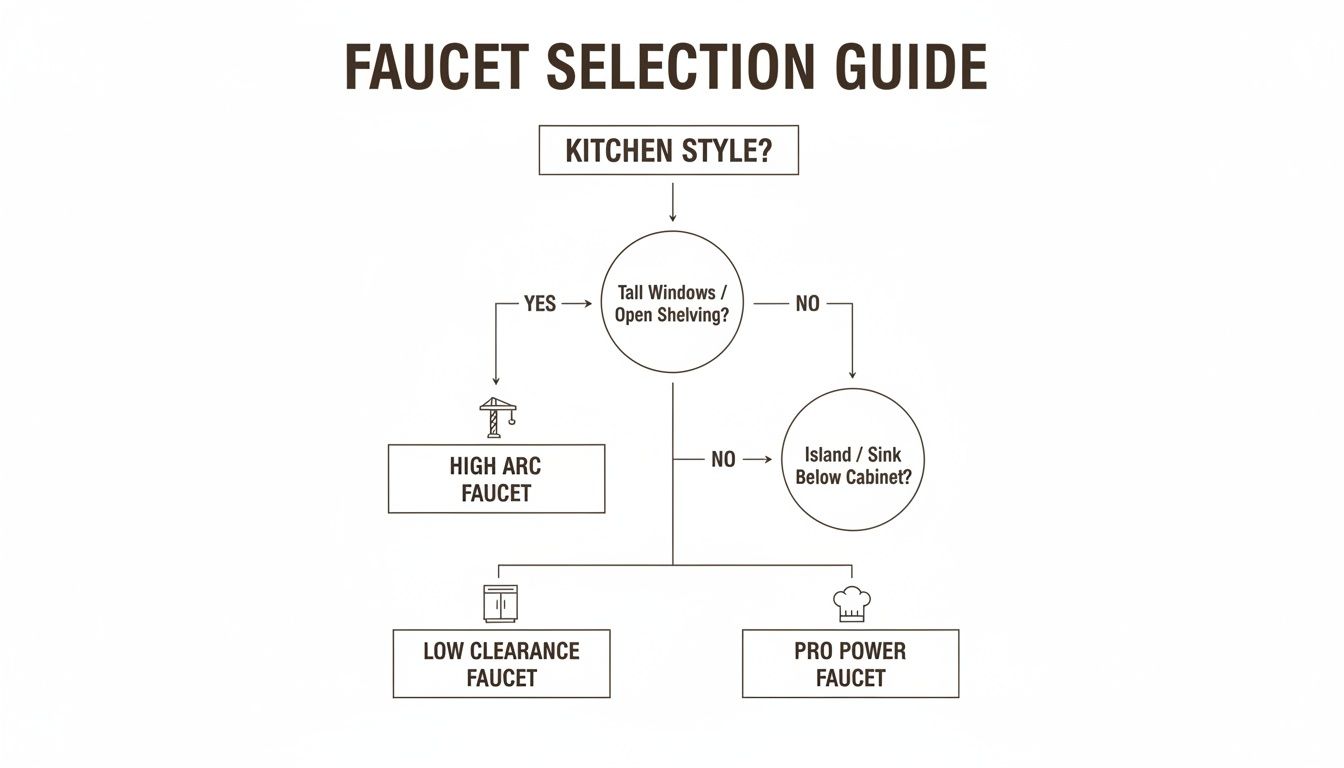
Sprayer style is one of the first big decisions to make. It determines not only how your faucet looks, but how it behaves in everyday use. The three main types are pull‑down, pull‑out, and semi‑pro, and each suits different layouts and habits.
You can think of them as different tools:
-
A pull‑down faucet acts like a crane, reaching deep into the sink.
-
A pull‑out faucet behaves like a handheld wand, offering precise control in tighter spaces.
-
A semi‑pro faucet mimics professional restaurant fixtures, providing maximum reach and flexibility.
Demand for pull‑down and pull‑out designs has steadily increased as homeowners look for easier rinsing, cleaning, and filling options in modern kitchens.
The High‑Arc Pull‑Down Faucet
Pull‑down faucets are especially common in contemporary kitchens. They typically feature a tall, high‑arc spout with a spray head that pulls straight down into the sink, with the hose hidden inside the spout for a clean, streamlined look.
Key benefits:
-
The downward pull motion feels natural and ergonomic.
-
The high arc provides generous vertical clearance, making it easier to fit large pots and baking trays underneath.
Best for: Deep, single‑basin or farmhouse sinks where vertical room inside the bowl is important.
Heads up: Measure from the countertop to the bottom of any cabinet or shelf above the sink to ensure there is enough space for a high‑arc design to move freely.
The Compact Pull‑Out Faucet
Pull‑out faucets usually have a lower spout profile. The spray head pulls forward toward you rather than down into the sink.
Key benefits:
-
The forward pull is convenient for filling containers on the countertop, such as coffee pots or watering cans.
-
This style works well in kitchens with shallow double sinks or limited overhead clearance.
It is a common assumption that pull‑out faucets always have shorter hoses, but many models offer a usable reach similar to typical pull‑down designs; the main difference is the direction of movement and how you hold the spray head.
Best for: Shallow double‑basin sinks and installations with cabinets directly above the sink.
The Powerful Semi‑Pro Faucet
Semi‑pro faucets take inspiration from commercial kitchens. They often feature an exposed spring or coil surrounding a flexible hose, with the spray head docked at a holder that can be easily released.
Key benefits:
-
Long reach and flexible positioning, often allowing the spray head to move around most of the sink area.
-
Strong spray options that are well‑suited to heavy‑duty cleaning and prep work.
Best for: Large sinks, kitchen islands, and cooks who frequently handle substantial cleaning tasks.
Heads up: These designs are visually bold and physically larger, so they look best in kitchens with enough visual and physical space.
Sprayer Faucet Styles at a Glance
| Feature | Pull‑Down Faucet | Pull‑Out Faucet | Semi‑Pro Faucet |
|---|---|---|---|
| Primary motion | Pulls straight down into the sink | Pulls straight out toward you | Unhooks from a holder and moves freely |
| Best for sinks | Deep, single‑basin or farmhouse sinks | Shallow or double‑basin sinks | Large and oversized sinks |
| Key advantage | Ergonomic for large pots and deep bowls | Easy countertop filling, good for low space | Maximum reach and strong spray options |
| Aesthetic | Elegant high‑arc gooseneck | Compact, lower‑profile spout | Bold, professional, exposed coil |
| Ideal user | Everyday home cook | Users with space or height constraints | Enthusiastic home cook needing pro‑style power |
Ultimately, the right choice depends on your sink type, kitchen layout, and the tasks you perform most frequently.
Must‑Have Features for a High‑Performance Sprayer Faucet
After choosing a style, the next step is to look at performance details. The difference between a “nice‑looking” faucet and the best kitchen faucet with sprayer often lies in how versatile and reliable it is over time.
Ask yourself:
-
Can it switch easily between gentle rinsing and vigorous cleaning?
-
Is the hose long enough to reach all areas you need?
-
Does the spray head dock securely without sagging?
-
Is the flow rate efficient but still practical for daily use?
Versatility in Spray Modes
A modern sprayer faucet should handle multiple tasks, so at least two distinct water patterns are important:
-
Aerated stream – Mixes water with air to create a soft, reduced‑splash flow. Ideal for filling pots, washing hands, and rinsing delicate produce.
-
Powerful spray – Provides a stronger pattern for removing food residues, rinsing the sink, and handling tougher cleaning jobs.
Some premium models add a pause button on the spray head, allowing you to temporarily stop the flow without turning off the handle. This can help conserve water when moving between the sink and the countertop.
The faucet’s real value comes from how easily it adapts from gentle prep tasks to intensive cleanup.
Hose Length and Secure Docking
A sprayer is only as useful as its reach. For many residential faucets, a hose extension in the range of roughly 15 to 20 inches is common and generally enough to reach all corners of a standard sink. Some products use longer hoses overall, but the effective working extension is what matters most in daily use.
Just as important is how the spray head docks:
-
Magnetic docking uses magnets to guide and hold the head firmly in place.
-
Counterweight systems use a weight on the hose under the sink to help retract the spray head smoothly.
A well‑designed docking system prevents the “drooping sprayer” issue and keeps the faucet looking neat and functioning properly.
Understanding Flow Rate and Certifications
Flow rate, measured in gallons per minute (GPM), tells you how much water the faucet uses. Federal efficiency standards in the United States require kitchen faucets to have a maximum flow rate of 2.2 GPM at 60 psi. Many modern kitchen faucets are designed to deliver good performance at lower flow rates, such as around 1.8 GPM, to reduce water use while remaining practical.
For many households, a faucet in the range of roughly 1.5–1.8 GPM offers a reasonable balance between efficiency and usability.
Certifications are equally important:
-
The cUPC mark (issued through IAPMO R&T) indicates that the faucet has been tested for compliance with the Uniform Plumbing Code requirements for plumbing fittings, including structural integrity and performance.
-
To demonstrate compliance with modern “lead‑free” regulations in the U.S., manufacturers typically rely on certifications to standards such as NSF/ANSI/CAN 61 and NSF/ANSI/CAN 372, which confirm that wetted surfaces meet a weighted average lead content limit of ≤0.25% under the Safe Drinking Water Act.
Choosing a faucet that clearly documents these certifications gives you added assurance about both safety and quality.
Matching Faucet Materials and Finishes to Your Kitchen
While the sprayer’s function is essential, the material and finish are what you see and touch every day. They affect durability, ease of cleaning, and how well the faucet complements your décor.
Comparing Popular Faucet Finishes
Different finishes offer distinct looks and maintenance characteristics:
-
Matte black – Provides a modern, high‑contrast appearance and often hides fingerprints better than highly polished finishes.
-
Brushed nickel – Offers a soft metallic sheen that works with many styles; the brushed texture helps camouflage water spots and smudges.
-
Polished chrome – Delivers a bright, mirror‑like shine and is widely used, but it can show fingerprints and spots more easily, needing more frequent wiping.
The right finish does more than look good—it also influences how much day‑to‑day cleaning is needed.
Why Core Materials Matter for Longevity
Under the finish, the core metal has a major impact on strength, corrosion resistance, and water safety:
-
Solid brass has long been a standard for plumbing fixtures due to its durability and corrosion resistance. Modern “lead‑free” brass used for potable water fittings is formulated to meet regulations that limit the weighted average lead content on wetted surfaces to ≤0.25%, in line with the U.S. Safe Drinking Water Act and NSF/ANSI/CAN 372.
-
304 stainless steel is another premium choice. It provides excellent resistance to rust and corrosion and contains no intentional lead alloying, making it suitable for faucets that contact drinking water when properly certified.
These robust materials, paired with a durable finish and appropriate certifications, help ensure that your faucet maintains both performance and safety over many years.
Market research on faucets notes growing interest in durable materials, water‑efficient performance, and flexible sprayer designs in residential kitchens, particularly in renovation projects.
A Practical Checklist for Installation and Maintenance
Selecting a good faucet is the first step; proper installation and regular care are what keep it performing well.
Pre‑Installation Compatibility Checklist
Before installing a new faucet, confirm that it matches your sink and plumbing:
| Check point | What to measure or verify | Why it matters |
|---|---|---|
| Sink hole count | Count existing holes in your sink or countertop. | Faucets are typically designed for 1‑hole or 3‑hole setups; you may need a deck plate to cover extra holes. |
| Water line size | Check the size of your shutoff valve connections. | Many modern faucets use 3/8‑inch compression connections; adapters may be necessary if yours differ. |
| Overhead clearance | Measure from the countertop to any cabinet above the sink. | High‑arc or semi‑pro faucets need sufficient vertical room to operate freely. |
These quick checks help prevent surprises and support a smooth, leak‑free installation.
Keeping Your Faucet in Top Shape
After installation, simple maintenance can extend the life of your faucet:
-
Cleaning the finish – Use a soft cloth with mild soap and water for routine cleaning, and avoid abrasive pads or strong chemicals that can damage the finish and seals.
-
Dealing with mineral buildup – In hard‑water areas, mineral deposits can accumulate on spray nozzles and aerators. Removing the spray head (if the design allows) and soaking it in a dilute vinegar solution, followed by a thorough rinse, can help dissolve buildup; always follow the manufacturer’s care instructions.
-
Periodic checks – Look occasionally for drips around the base or handle, and make sure the spray head docks securely. Addressing small issues early is easier than handling larger problems later.
Why Investing in a Quality Faucet Pays Off
A kitchen faucet is a daily‑use fixture that affects comfort, efficiency, and even perceived home value. A higher‑quality faucet usually offers:
-
Better internal components and sealing systems
-
Stronger, more corrosion‑resistant materials
-
Verified compliance with low‑lead and plumbing standards
-
Smoother operation and more reliable spray functions
Professional plumbing sources commonly note that a well‑made faucet, installed correctly and maintained, can provide many years of service, whereas lower‑quality fixtures may require more frequent repairs or earlier replacement.
A quality faucet is essentially a “buy it once, use it for years” decision. The upfront investment covers better engineering and safer materials, helping you avoid repeated replacement costs and inconvenience.
Common Questions, Answered
What’s a practical flow rate for a kitchen faucet?
Flow rate is measured in gallons per minute (GPM). Federal efficiency standards in the U.S. set a maximum of 2.2 GPM at 60 psi for kitchen faucets. Many modern, high‑efficiency models operate around 1.8 GPM, and some go lower, using smart internal design to maintain effective rinsing and filling. For most homes, choosing a faucet in the 1.5–1.8 GPM range provides a good balance between water savings and usability.
How do I keep my faucet’s finish looking new?
Avoid abrasive cleaners, harsh chemicals, and scratchy pads, which can dull or damage the finish. Instead, use a soft cloth, mild dish soap, and warm water for cleaning, then rinse and dry. This gentle, consistent care helps preserve the faucet’s appearance over time.
Can I install a new faucet myself?
Many modern kitchen faucets are designed to be DIY‑friendly, with flexible supply lines and simplified mounting hardware. If you are comfortable working under the sink and follow the manufacturer’s instructions carefully, self‑installation can be achievable. However, if you encounter issues such as corroded parts, non‑standard plumbing, or uncertainty about shutoff valves, hiring a licensed plumber is the safest way to ensure a secure, code‑compliant, and leak‑free installation.
Ready to find a faucet that combines thoughtful design with certified, reliable performance? The GRANDJOY collection offers a range of sprayer faucets built with durable materials, tested performance, and timeless style—designed to support everyday cooking, cleaning, and entertaining in your kitchen.


Leave a comment
This site is protected by hCaptcha and the hCaptcha Privacy Policy and Terms of Service apply.